

In the world of aggregate production, the synergy between primary and secondary crushing is the key to profitability. When you search for a mobile jaw crusher with impact diagram, you are looking for more than just a picture; you are looking for a system that balances reduction ratio with particle shape while maintaining total mobility.
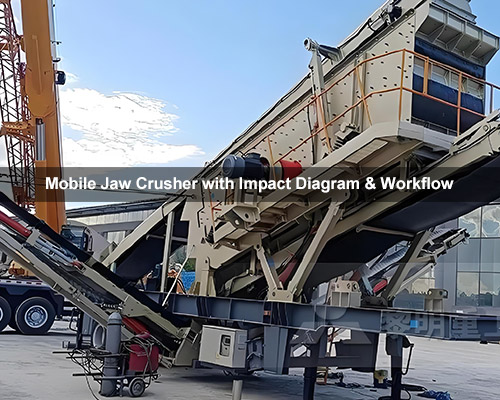
At Liming Heavy Industry, we have perfected this mobile configuration. By combining our robust K-Series Mobile Jaw Plant with our Mobile Impact Plant, we create a flexible production line that moves with your project.
Visualizing the Flow: The “Diagram” Explained
Understanding the diagram is crucial for optimizing your setup. In a typical Liming mobile crushing circuit, the workflow operates as follows:
- Feeding (Primary Stage): Raw material is fed via a vibrating feeder into the Mobile Jaw Crusher. Here, large boulders are reduced to medium size (coarse crushing).
- Transfer: A belt conveyor transports the coarse material to the second mobile chassis.
- Shaping (Secondary Stage): The material enters the Mobile Impact Crusher. High-speed blow bars impact the stone, breaking it along natural fissures to produce a cubic shape (fine crushing/shaping).
- Screening & Return (Closed Circuit): The material goes to a vibrating screen. Sized product is piled via output belts; oversized material is returned to the Impact Crusher via a return belt for re-crushing.
Solving Your Site Challenges
Why choose this specific configuration? Here is how Liming’s technology addresses three critical industry pain points:
1. Pain Point: “We lose weeks setting up concrete foundations.”
The Solution: True Mobility. Traditional plants require massive civil engineering. Liming’s Mobile Crushing Station (Wheel or Track-mounted) requires no concrete foundation. It can be driven directly to the mining face and set up in days, not months. This drastically reduces material transportation costs.
2. Pain Point: “Our aggregate shape is rejected by concrete plants.”
The Solution: The Impact Advantage. A jaw crusher alone often produces elongated particles. By integrating the Impact Crusher into the diagram, we utilize impact force rather than compression. This guarantees a product with excellent cubicity and no internal cracks, meeting high-grade construction standards.
3. Pain Point: “Secondary crushers keep jamming or wearing out.”
The Solution: Optimized Load Balancing. Our system allows for precise gap adjustment on the Jaw Crusher. By setting the correct discharge size at the primary stage, we ensure the Impact Crusher is not overloaded, reducing wear on blow bars and preventing blockages.
Project Spotlight: Limestone Crushing in Kenya
Location: Nairobi, Kenya
Material: Hard Limestone
Capacity: 150-180 Tons Per Hour (TPH)
Configuration:
- Primary: Liming KE600 Mobile Jaw Crusher Station
- Secondary: Liming KF1214 Mobile Impact Crusher Station
Result: The client needed to supply aggregate for a highway project. The dual-mobile setup allowed them to finish one quarry section and move the entire plant 50km to the next site within 48 hours. The final product shape met the strict requirements of the local road authority.
Expert Advice: A Note from Our Chief Engineer
“Hello, I’m Engineer Zhang from Liming’s R&D department. With 20 years in the field, here is a tip many operators miss when looking at the mobile jaw crusher with impact diagram:”
“Don’t ignore the pre-screening function on the feeder. Many users feed everything into the Jaw Crusher. However, if your raw material contains a lot of soil or fines (0-50mm), you should set the grizzly bars on the feeder to bypass the Jaw Crusher. Let these fines go directly to the conveyor or a side belt. This increases the Jaw Crusher’s total throughput by up to 20% and prevents the Impact Crusher from dealing with unnecessary mud.”
FAQ: Mobile Crushing Systems
Can the Jaw and Impact crusher be mounted on a single mobile chassis?
For smaller capacities, yes. Liming offers “4-in-1” compact mobile stations. However, for capacities above 100TPH, we recommend separate chassis (one for Jaw, one for Impact) to ensure easier maintenance and higher efficiency.
Is the mobile impact crusher suitable for granite?
Impact crushers are best for soft to medium-hard stones (Limestone, Gypsum). For very hard abrasive stones like Granite, while an impact crusher provides good shape, wear costs will be higher. In such cases, a Mobile Cone Crusher might be a better secondary option. Liming experts can help you choose based on your budget.
What is the difference between tire-type and crawler-type mobile crushers?
Tire-type (Wheel) is towed by a truck and is ideal for sites with flat terrain or where the plant moves between different sites via highways. Crawler-type (Track) moves on its own tracks, making it perfect for climbing steep mining faces or operating in wetland environments.
How is the power supplied to these mobile stations?
Most Liming mobile stations offer dual-power options: they can run on the local electric grid (cheapest operation) or use an onboard diesel generator (maximum flexibility in remote areas).
Visualize Your Success with Liming
A diagram is just the beginning. You need machinery that turns that plan into profit.
Whether you need a standalone mobile jaw crusher or a complete multi-stage mobile plant, Liming Heavy Industry has the engineering expertise to build it.