

Are you struggling with high wear part replacement costs, frequent downtime, or poor-quality aggregate shapes in your quarry? For mining engineers and quarry owners in fast-developing regions across Africa, Southeast Asia, and South America, maximizing profitability starts with plant design. Designing the optimal stone crushing line equipment configuration is the most critical step to ensuring long-term operational success, reducing operational expenditure (OPEX), and meeting strict local construction standards.
A poorly matched production line leads to bottlenecks, excessive energy consumption, and high maintenance costs. Conversely, a scientific and customized approach guarantees high throughput and excellent final product cubicity. As a global leader in crushing and grinding equipment, Liming Heavy Industry provides customized, high-efficiency production line solutions tailored to your specific raw materials, capacity needs, and site conditions.
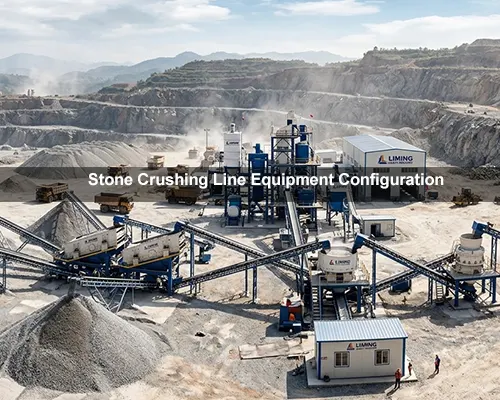
The Standard Flow Chart of a Stone Crushing Plant
Before diving into specific machine models, it is essential to understand the standard workflow of aggregate production. A complete stone crushing line typically follows a four-stage process:
- Feeding: Raw materials blasted from the mountain are fed smoothly into the primary crusher.
- Primary Crushing: Large boulders are reduced to a manageable size.
- Secondary Crushing: Medium-sized stones are crushed into smaller aggregates.
- Tertiary Crushing / Shaping & Screening: Materials are finely crushed, shaped to remove flakiness, and separated into standardized commercial sizes (e.g., 0-5mm, 5-10mm, 10-20mm).
Core Equipment List for Your Production Line
To achieve the best stone crushing line equipment configuration, selecting the right machinery for each stage is vital. Liming Heavy Industry manufactures a complete suite of robust, technologically advanced equipment.
1. Primary Crushing: Jaw Crushers
The Jaw Crusher is the undisputed workhorse of the primary crushing stage. It is designed to handle large, hard, and abrasive materials like granite, basalt, and river pebbles.
- C6X Series Jaw Crusher: Features a detachable frame without welding, double-wedge adjusting device, and high-quality forged drop spindle. Ideal for large-scale mining operations requiring maximum reliability.
- PEW Series European Jaw Crusher: Optimized crushing cavity and heavy-duty eccentric shaft ensure high crushing ratios and durability.
2. Secondary Crushing: Cone Crushers vs. Impact Crushers
The choice of secondary crusher depends entirely on the hardness of your raw material. Using the wrong machine here is the leading cause of high wear-part costs.
| Feature | Cone Crusher (e.g., HST, HPT Series) | Impact Crusher (e.g., CI5X Series) |
|---|---|---|
| Best For Raw Material | Hard and highly abrasive rock (Granite, Basalt, River Stone, Quartzite) | Medium-hard and brittle rock (Limestone, Concrete, Dolomite) |
| Working Principle | Lamination crushing (squeeze and grind) | Impact crushing (strike and throw) |
| Final Product Shape | Good, but may require a VSI shaper for strict highway standards | Excellent cubical shape, very low flakiness |
| Wear Part Cost | Very low (highly durable mantles and bowl liners) | Higher if used on abrasive rock (blow bars wear quickly) |
3. Sand Making & Shaping: VSI Crushers
If your market demands high-quality manufactured sand or premium aggregates for highway and high-speed railway construction, a Vertical Shaft Impact (VSI) crusher is mandatory. Liming’s VSI6X Series Sand Making Machine utilizes a “rock-on-rock” and “rock-on-iron” crushing principle, dramatically improving the cubicity of the final product while producing high-grade artificial sand.
4. Auxiliary Equipment: Vibrating Feeders & Screens
- Vibrating Feeders: Ensure a continuous, uniform feed to the primary jaw crusher, preventing blockages. TSW Series grizzly feeders can also pre-screen soil and fine dirt.
- Vibrating Screens: S5X Series vibrating screens efficiently classify the crushed material into different output sizes. Any oversized material is looped back to the secondary or tertiary crusher via a closed-circuit system.
[Insert Image: Close up of a Liming S5X Vibrating Screen classifying aggregates with Alt Text: heavy duty vibrating screen for aggregate classification]
Customized Configurations Based on Capacity
Every quarry project is unique. Below are two highly popular configurations deployed by our clients in Africa and Southeast Asia.
Configuration A: 150-200 TPH Hard Rock Crushing Line (Granite)
For highly abrasive materials, a Jaw + Cone setup is the most economical configuration over the long term, drastically reducing wear part consumption.
- Feeder: TSW0932 Vibrating Feeder
- Primary Crusher: PEW760 Jaw Crusher
- Secondary Crusher: HST100 Single Cylinder Hydraulic Cone Crusher
- Screening: 3YZS2160 Vibrating Screen
- End Products: 0-5mm, 5-10mm, 10-20mm
Configuration B: 250-300 TPH Soft Rock Crushing Line (Limestone)
For softer materials, an Impact Crusher provides a higher reduction ratio and better product shape in fewer stages, reducing initial capital investment.
- Feeder: TSW1139 Vibrating Feeder
- Primary Crusher: PEW860 Jaw Crusher
- Secondary Crusher: CI5X1315 Impact Crusher
- Screening: S5X2160 Vibrating Screen
- End Products: 0-5mm, 10-20mm, 20-31.5mm
Advantages of Liming Heavy Industry’s Solutions
When you partner with Liming Heavy Industry, you are not just buying machines; you are investing in a comprehensive, revenue-generating system.
- High Reliability & Uptime: Designed with heavy-duty components capable of withstanding the harsh environments often found in tropical and arid mining regions.
- Intelligent Control Systems: Our modern plants feature PLC automation, allowing operators to monitor lubrication, hydraulic pressure, and motor temperatures remotely, preventing catastrophic failures.
- Modular & Compact Design: Reduces the footprint of the plant and minimizes civil engineering and foundation costs.
- Eco-Friendly Operations: Integrated dust suppression systems and noise reduction enclosures ensure compliance with local environmental regulations.
ROI Analysis for Quarry Owners
A superior stone crushing line equipment configuration optimizes both Capital Expenditure (CAPEX) and Operational Expenditure (OPEX). While cheaper, mismatched equipment might save you 15% upfront, it can cost you 50% more in maintenance, electricity, and lost production time over a single year.
By implementing a Liming customized layout—specifically matching the crusher type to the rock hardness—our clients typically see a reduction in power consumption by 15-20% and a decrease in wear-part replacement frequency by up to 30%. For a standard 200 TPH plant, this operational efficiency often results in a full return on investment (ROI) within 8 to 14 months of continuous operation.
Frequently Asked Questions (FAQ)
1. How do I choose between a cone crusher and an impact crusher for my secondary stage?
The primary deciding factor is the compressive strength and abrasiveness of your stone. If you are crushing hard rock like granite, basalt, or river pebbles, a cone crusher is essential to keep wear-part costs low. If you are crushing soft to medium-hard rock like limestone, an impact crusher is preferred because of its lower initial cost and superior cubical final product shape.
2. What is the estimated cost of a complete stone crushing line?
The total investment varies significantly based on capacity (TPH), raw material hardness, required final product sizes, and mobility (stationary vs. mobile plant). A small 50 TPH plant will cost substantially less than a fully automated 500 TPH line. For an accurate quote, it is best to provide your specific parameters to our engineering team.
3. Can Liming equipment handle highly abrasive materials like river stone?
Yes. For highly abrasive materials like river stone (cobble), we strongly recommend our HPT Multi-Cylinder Hydraulic Cone Crusher or HST Single-Cylinder Cone Crusher for the secondary stage, paired with a VSI6X Sand Maker for shaping. This specific stone crushing line equipment configuration is engineered to minimize metal wear and maximize output efficiency.
Conclusion
Designing the right stone crushing plant is a complex engineering task that directly dictates your quarry’s profitability. From the robust primary jaw crushers to the precision of our VSI sand makers, ensuring the perfect stone crushing line equipment configuration allows you to produce high-quality aggregates at the lowest possible cost per ton.