

Deconstructing Circuit Geometry in Gold Ore Types and Extraction Method Architecture
Quartz Vein Reduction and Mill Media Degradation
Bypassing secondary kinetic reduction destroys your metallurgical yield velocity.
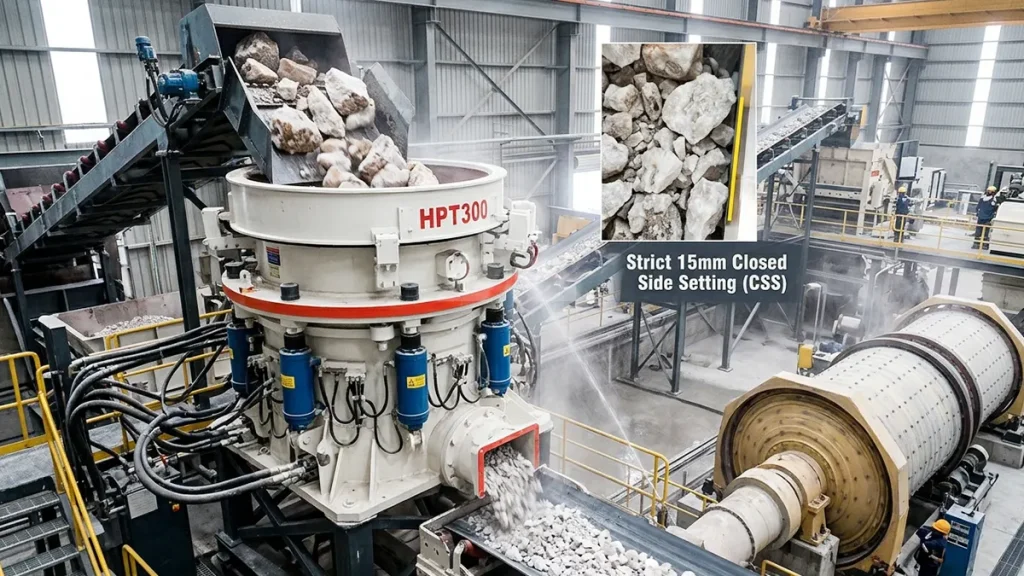
I constantly have to audit and redraw processing flowcharts because a novice designer misunderstood the hardness of quartz. High-silica quartz vein gold deposits routinely exceed 250MPa. Feeding this abrasive, uncalibrated rock directly into a ball mill without utilizing an HPT300 secondary cone crusher is an architectural disaster. The massive steel balls inside the mill are designed for attrition and fine grinding, not primary impact.
The 250MPa quartz will violently degrade the mill’s grinding media.
Within weeks, the steel balls deform, the mill’s throughput collapses, and the metallurgical yield velocity drops by 40%. The spatial architecture of the plant must mandate a strict two-stage crushing circuit. The HPT300 cone crusher, operating with a tightly calibrated Closed Side Setting (CSS), must reduce the primary jaw output to a strict 0-12mm profile. Only then is the material geometrically prepared for the tumbling friction of the ball mill.
Placer Gold Physics and Cavity Blinding
Not all gold requires kinetic violence. Placer gold (alluvial) extraction relies on gravity and fluid dynamics, not brute force. The gold particles are already liberated from the host rock, sitting loose within river gravel, clay, and mud. Attempting to run this sticky, high-moisture material through a compressive jaw crusher like the C6X100 is a fundamental misunderstanding of the geology.
The mud will instantly blind the V-cavity, stalling the 110kW motor.
An architect must specify a completely different flow. The primary node for alluvial types demands heavy-duty rotary trommel screens and high-volume wash plants. You use water to break the clay bonds, not steel plates. Forcing a hard-rock extraction method onto a soft-rock geology guarantees a permanent mass balance deficit and an immediate halt to your daily production.
The extraction circuit must be rigidly synchronized to the specific mineralogical host.
| Ore Geology | Primary Reduction Model | Secondary Shaping | Extraction Chemistry/Physics |
|---|---|---|---|
| High-Silica Quartz Vein | C6X125 Jaw (160kW) | HPT300 Cone (0-12mm) | Cyanidation (CIP/CIL) |
| Refractory Sulfide | PEW860 Jaw | HPT200 Cone + Ball Mill | Flotation + Roasting |
| Alluvial Placer | Trommel Screen (No Jaw) | Hydrocyclone Classification | Centrifugal Gravity Separation |
Notice the strict absence of a jaw crusher in the Alluvial Placer stage. Implementing a C6X125 here would not only fail mechanically, but it would waste 160kW of power per hour attempting to crush mud.
Refractory Sulfides and Closed-Circuit Classification
In refractory sulfide gold ores, the gold is microscopically locked within dense pyrite matrices. You cannot simply crush this rock and expose it to cyanide; the chemical will never reach the gold. The flowchart must mandate a highly synchronized closed-circuit grinding stage.
Field Note: I inspected a flotation circuit in Nevada where the hydrocyclone overflow was uncalibrated. Coarse, unliberated pyrite particles (+100 mesh) bypassed the mill, sinking straight to the bottom of the flotation cells and dragging millions in trapped gold into the tailings.
Hydrocyclones must strictly classify the slurry exiting the ball mill. The physics of centrifugal force ensure that only perfectly liberated -200 mesh particles proceed to the flotation cells. Any coarse material must be aggressively diverted back to the mill for re-grinding. Breaking this closed-circuit loop guarantees that coarse gold bypasses the extraction method entirely.
Refractory Gold Circuit: Mass Balance Thresholds
- Primary Extraction: C6X125 Jaw sustaining 230-760 tph
- Secondary Calibration: HPT300 Cone locked at 15mm CSS
- Grinding Medium: High-chrome forged balls matching 0-12mm feed
- Hydrocyclone Classification: Strict -200 mesh overflow threshold
- Flotation Feed: 100% liberated pyrite matrix prior to roasting
LH-GOLD_ORE_TYPES_AND_EXTRACTION_METHOD-June/2026-Ref-#49182
Enforcing Strict Architectural Hierarchy
A gold processing plant is not a generic rock quarry; it is a highly calibrated chemical and physical laboratory. The spatial architecture must rigidly obey the geology. Feeding 250MPa quartz into a mill without an HPT300 cone destroys your grinding media. Over-grinding the ore generates 10-micron slime that asphyxiates your CIP carbon. If you attempt to blur these boundaries next month by ignoring CSS calibration or misaligning your hydrocyclones, the resulting mass balance deficit will hemorrhage your liberated gold directly into the tailings pond.