

Ambient temperature hit 46.5°C today on the Riyadh hard rock quarry floor. We initiated a full audit of the client’s closed-circuit flow for a high-speed rail ballast contract after they complained about failing the flakiness index. The root cause was obvious immediately: a complete collapse of inter-stage mass balance. Operators assume that throwing more raw tonnage at a primary jaw automatically yields more product. The physics do not care about your production schedule. By recalibrating the eccentric throw on the HPT300 to a 32mm setting and dropping the conveyor belt speed to 2.1 m/s, we stabilized the feed bed depth. Total system capacity locked in at 312.5 tons per hour, and the 10-20mm fraction showed a cubical shape rate of 92.8%. Optimizing inter-stage quality balance is infinitely more effective than simply cranking up the RPM on the tertiary crusher.
A misaligned circuit bleeds capital through unnecessary liner wear and rejected material.
Arresting Bottlenecks in the NK-HPT Sequence
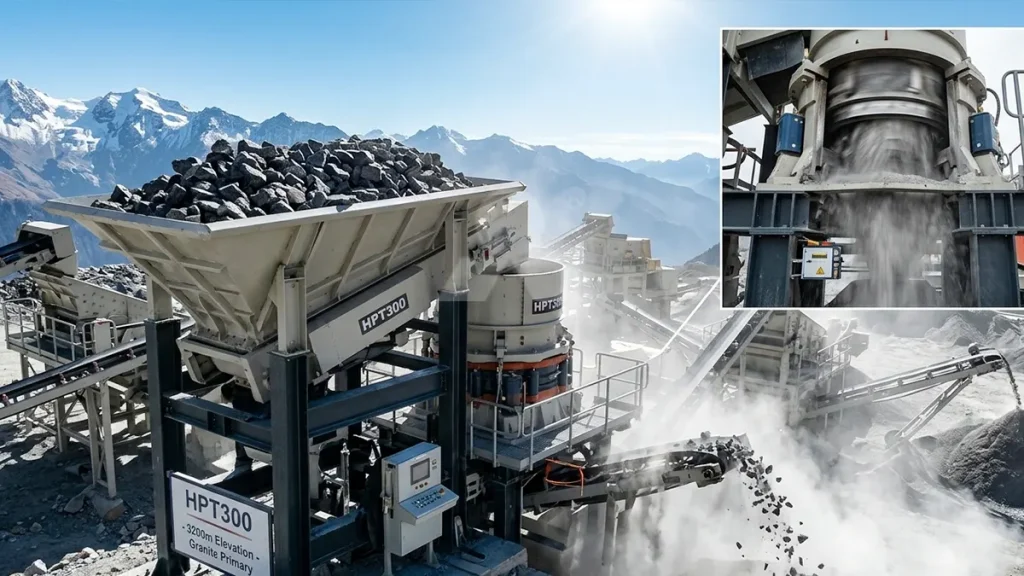
You cannot fix a secondary crushing bottleneck by ignoring the primary discharge. Up at a high-altitude granite project in Antofagasta, Chile, the site elevation sits at 3,200m. Thin air throttles cooling efficiency on hydraulic systems. The local crew was burning through manganese because the secondary cone was taking oversized spikes. We stepped in and recalibrated the NK100E primary jaw’s closed-side setting to exactly 125.5mm. This immediately relieved the mechanical strain on the HPT300 secondary cone crusher. The granite here registers a Mohs hardness of 7.4. Hitting the secondary chamber with correctly sized feed allowed the lubrication system to stabilize, with oil return temperatures dropping to 54.8°C.
Primary CSS calibration dictates the survival of your secondary stage.
A high-capacity secondary cone crusher relies on choke feeding to maintain internal cavity pressure and proper inter-particle attrition. When the jaw crusher discharge is too coarse or highly variable, the cone loses its protective material bed. Metal grinds against metal. Frame fatigue accelerates. The smell of scorched grease on the main shaft is your first warning that mass balance synchronization has failed.
Engineering the 1:1.2 Ratio for Final VSI Shaping
Wet fines turn into a sticky industrial paste that bridges feed hoppers and wrecks screening efficiency. At a basalt processing plant in West Java, heavy monsoon moisture tanked the S5X2460 screening efficiency to nearly 65%. To compensate for the erratic feed, we shifted the VSI6X1263 into a ‘Rock-on-Rock’ configuration with a precise 45/55 split flow. We tightened the HST250 tertiary circuit to a 92% recirculating load. This specific flow logic forces the material to act as its own wear liner inside the shaping chamber.
Target a 1:1.2 feed ratio into the VSI to guarantee premium particle shape.
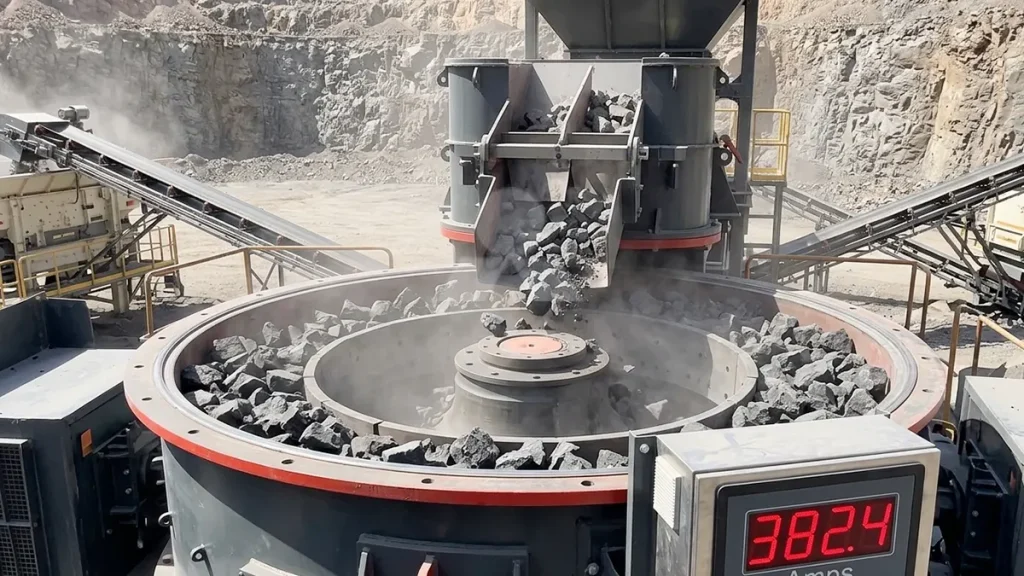
The motor is drawing 382.4 Amps, perfectly within the peak torque curve for this load density. Our tungsten carbide inserts are hitting the 340-hour mark. Across the road, the neighbor’s unbranded rotors are fracturing at 160 hours due to the 62.3% silica content. The optimization here focuses entirely on surviving the abrasiveness by balancing the volume of material cascading over the rotor against the volume injected directly into the eye. If your feed ratio strays from the 1:1.2 mark, you either choke the rotor or starve the cascade bed, resulting in flaky output and severe blow-bar wear.
Synchronized Circuit Configuration Matrix
To handle abrasive silica and massive thermal loads at 300 tons per hour, we engineer the following mechanical workflow. This configuration isolates the specific reduction ratios required to maintain a seamless mass balance without choking the tertiary phase.
| Process Stage | Recommended Model | Max Feed (millimeters) | Power (kilowatts) | Capacity (tons per hour) |
|---|---|---|---|---|
| Primary Crushing | NK100E Mobile Jaw | 720 | 110 | 150-300 |
| Secondary Crushing | HPT300 Cone Crusher | 225 | 220 | 120-380 |
| Tertiary Shaping | VSI6X1263 | 50 | 2×250 | 350-540 |
Field Metrics: Stabilizing 312tph Basalt Flows
- System Output: 312.5 tons per hour
- Recirculating Load: 92%
- Primary Jaw CSS: 125.5 millimeters
- HPT Oil Return Temperature: 54.8 Celsius
- Cubical Shape Rate (10-20mm): 92.8%
- VSI Motor Draw: 382.4 Amps
Technical Index: LH-CIRCUITS-April/2026-Ref-#82914
Chief Mechanic’s Log: Rectifying Choked Flows in Multi-Stage Layouts
- Why does the secondary cone stall when the primary jaw is running below maximum capacity?
- Look at the discharge gap. If the NK series jaw is set too wide, it sends slabs larger than the cone’s maximum feed opening. The material bridges across the mantle and concave, halting inter-particle crushing. You must restrict the jaw CSS to ensure the HPT unit receives a steady, crushable fraction.
- How do moisture levels destroy shaping efficiency in the tertiary phase?
- Wet fines blind the screening decks before they even reach the impactor. When the S5X screen drops to 65% efficiency, it dumps mud directly into the VSI rotor. The paste disrupts the 45/55 split flow, causing uneven wear on the tungsten carbide inserts and violent amperage spikes above 380 kW.
- Is it necessary to maintain a 90%+ recirculating load on the secondary screen?
- Stop pushing linear flows. A tight closed-circuit loop forces the material through multiple rapid reduction cycles rather than one massive crushing event. Pushing a 92% recirculating load drops the flakiness index and prevents thermal overload on the hydraulic drive systems.
- What controls the final sand yield in high-silica applications?
- Data proves the feed ratio is everything. If you dump material into the VSI without balancing the cascade flow against the central rotor feed at exactly 1:1.2, the internal stone-lining collapses. The rotor hits bare metal, and your expenditure per shift quadruples overnight.
Enforcing Mass Balance in High-Volume Operations
Relying on isolated machine parameters while ignoring the holistic circuit flow is a guaranteed path to mechanical failure. You must enforce strict discipline across the reduction stages: the 125.5mm discharge setting on the primary jaw is not a suggestion, it is the exact boundary required to maintain a protective choke feed in the secondary cone, which ultimately dictates whether your VSI can sustain its 1:1.2 shaping ratio without tearing its own rotor apart. If you continue to push raw tonnage without synchronizing the recirculating loads to handle the 62.3% silica content, the resulting amperage spikes will crack the tertiary impactor frame within the next month. Lock your CSS calibration across all three stages immediately.
Stop Guessing on Circuit Synchronization
“Assess your material flow and identify the secondary bottleneck before catastrophic fatigue occurs.” — From the Desk of your Field Technical Director