

Executive Summary: Processing highly abrasive basalt requires a rigid two-stage compression crushing circuit. For a baseline 200-300 Tons Per Hour (TPH) capacity, deploying a C6X Series Jaw Crusher paired with an HST Single-Cylinder Cone Crusher optimizes reduction ratios while mitigating silica-induced wear, directly lowering cost per ton.
Key Takeaways
- Material Assessment: Basalt’s high compressive strength dictates a Jaw-Cone configuration; impactors are strictly avoided due to extreme blow bar wear.
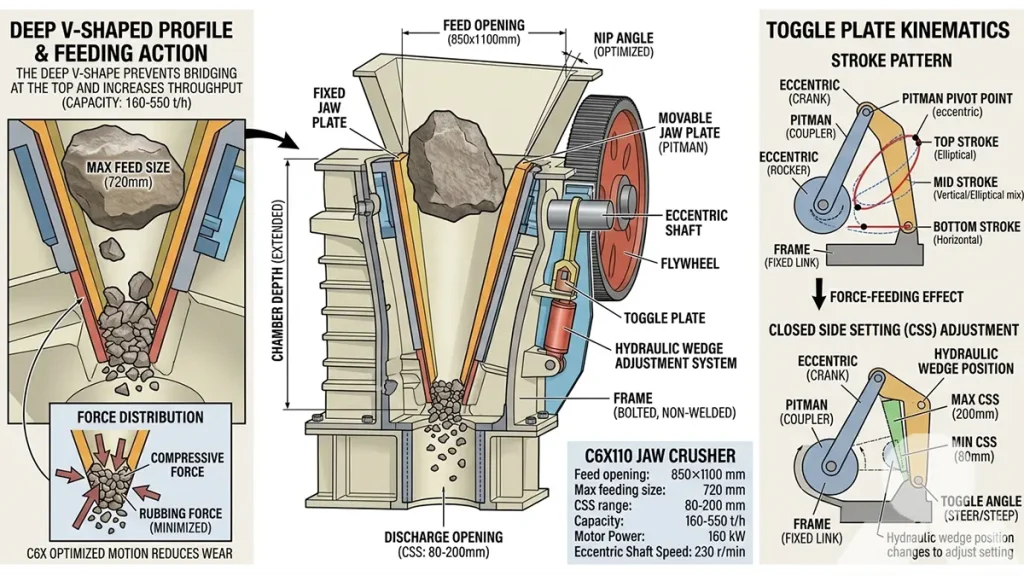
- Primary Reduction: The C6X110 Jaw Crusher provides a 720mm max feed capacity, establishing a consistent throughput baseline.
- Circuit Design: Implementing a closed-circuit screening phase guarantees strict control over final product gradation and enhances cubical particle shape.
The Engineering Challenge of Basalt Processing
Based on recent commissioning data across heavy infrastructure projects, basalt presents a unique metallurgical challenge. Its microcrystalline structure and high silica content make it exceptionally abrasive. When quarry operators attempt to process basalt using equipment calibrated for medium-hard limestone, they experience premature liner failure and severe mechanical fatigue. A successfully engineered basalt aggregate production line technical process must prioritize compressive crushing forces and robust wear materials to maintain continuous operation.
Detailed Process Flow & Equipment Configuration
1. Primary Feeding and Coarse Crushing
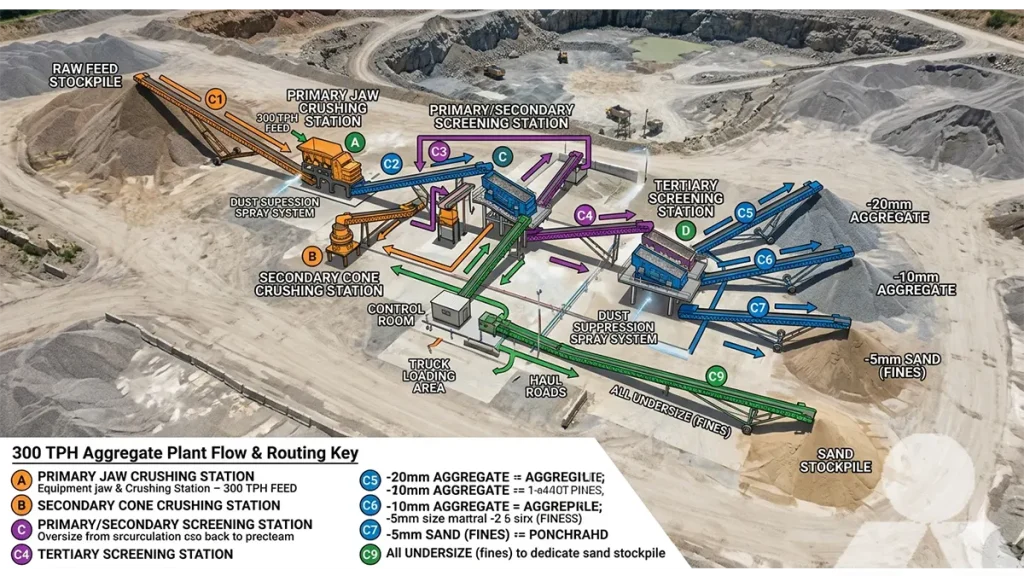
The operation begins at the dump hopper, where run-of-mine basalt is deposited. A TSW1139 Vibrating Feeder (150-350 TPH capacity) regulates the flow of raw material. Crucially, the TSW series features a grizzly section that bypasses undersized fines and soil directly to the screening stage, preventing the primary chamber from choking.
The screened heavy rock enters the C6X110 Jaw Crusher. Powered by a 160kW motor, this heavy-duty unit handles feed sizes up to 720mm. Its optimized crushing kinematics ensure a reliable primary reduction ratio, discharging material at a manageable size for the secondary stage.
2. Secondary Medium and Fine Crushing
The discharged material is transported via a B6X Belt Conveyor to the secondary crushing stage. For abrasive rock, the HST250 Single-Cylinder Hydraulic Cone Crusher is the standard. Operating at 250kW, the HST series utilizes a fully automated control system (CSS regulation) to maintain a consistent discharge opening even as the mantle and bowl liner wear. This ensures the output gradation remains stable without requiring manual mechanical adjustments.
3. Classification and Closed-Circuit Routing
Crushed basalt from the HST250 is conveyed to an S5X2160-3 Vibrating Screen. This 3-layer screen classifies the aggregate into standard market sizes (e.g., 0-5mm, 5-10mm, 10-20mm). Any oversize material retained on the top deck is routed back to the cone crusher via a return conveyor, forming a closed-circuit crushing loop. This continuous recirculation is vital for reducing flakiness and improving the cubical integrity of the final aggregate.
Beyond CapEx: The 10-Year TCO Advantage
When procuring a heavy-duty crushing circuit, evaluating Capital Expenditure (CapEx) in isolation is a critical engineering error. Over a standard 10-year operational lifecycle, the initial purchase price accounts for a fraction of the Total Cost of Ownership (TCO).
In high-abrasion applications like basalt, Operating Expenditure (OpEx)—specifically energy consumption, wear part replacement, and unplanned downtime—dictates profitability. Liming’s HST Cone Crushers utilize thicker, high-manganese alloy liners and integrated hydraulic lubrication systems. While this increases the upfront CapEx compared to standard spring-cone models, it extends the Mean Time Between Failure (MTBF) by up to 40%. In a 300 TPH operation, preventing just three days of unplanned downtime per quarter fundamentally shifts the Return on Investment (ROI) trajectory.
Technical Equipment Specifications (200-300 TPH Circuit)
The following table outlines the precise machine parameters selected from the Liming Global Product Database for this specific geological profile:
| Equipment Stage | Model | Capacity (TPH) | Power (kW) | Max Feed (mm) |
|---|---|---|---|---|
| Vibrating Feeder | TSW1139 | 150-350 | 15 | 600 |
| Primary Jaw Crusher | C6X110 | 160-550 | 160 | 720 |
| Secondary Cone Crusher | HST250 | 90-605 | 250 | 450 |
| Vibrating Screen | S5X2160-3 | 85-700 | 30 | 200 |
“In our experience across multiple high-yield hard rock sites, properly matching the secondary cone’s cavity profile to the primary jaw’s discharge curve is the single most effective method for controlling fines generation and maximizing liner life.”
Frequently Asked Questions
Q: Why is an impact crusher generally not recommended for secondary basalt crushing?
A: Basalt has high compressive strength and significant silica content. Using an impact crusher results in excessive wear on the blow bars, leading to a drastic increase in OpEx and frequent downtime. A hydraulic cone crusher relies on compression rather than impact, significantly extending wear part longevity when processing highly abrasive rock.
Q: What is the optimal reduction ratio for a basalt primary jaw crusher?
A: For hard rock like basalt, the primary jaw crusher should maintain a reduction ratio of roughly 3:1 to 4:1. Attempting to force a higher ratio at the primary stage will stress the eccentric shaft and toggle plate, reducing the lifespan of the equipment.
Q: How does closed-circuit crushing improve basalt aggregate shape?
A: In a closed-circuit system, oversized material from the vibrating screen is continuously routed back to the cone crusher. This constant recirculation increases the ‘rock-on-rock’ interaction within the crushing chamber (attrition), which naturally breaks off sharp edges and improves the overall cubical shape of the final aggregate product.
Mitigating Silica-Induced Wear in High-Capacity Basalt Circuits
In typical high-capacity operations processing abrasive basalt, baseline models indicate that inadequate surge capacity between the primary and secondary stages will “starve” the cone crusher. Running a cone crusher underfed leads to severe liner-on-metal impact, destroying the mantle and bowl liner prematurely while generating excessive, unsellable micro-fines. The structural integrity of the HST250’s main shaft and automatic CSS regulation specifically combats this, provided the feed rate is continuous and choke-fed. Protecting your CapEx requires treating the >circuit as an integrated fluid dynamic, not just a collection of separate machines.
Author: Senior Crushing Circuit Engineer, Liming Heavy Industry.
With over 18 years of field experience in heavy mineral comminution and hard-rock quarry design, specializing in TCO reduction and high-abrasion circuit optimization across global mining sectors.