

Parameters 1 & 2: Closed Side Setting (CSS) and Open Side Setting (OSS)
The CSS is the geometric anchor of the final aggregate shape. Losing control of this gap instantly spikes the flakiness index.
The Closed Side Setting (CSS) dictates the narrowest distance between the mantle and the bowl liner at the bottom of the parallel zone. Tightening the CSS on an HPT300 to a strict 12mm doesn’t just reduce the rock size; it mathematically forces a high-density inter-particle bed to form. This bed is mandatory for laminated crushing, dropping the final flakiness index below 9%. The Open Side Setting (OSS) determines the maximum discharge dimension when the eccentric shaft swings away. The differential between the OSS and CSS dictates the volumetric expansion limit, governing how quickly the crushed material clears the chamber before it is crushed again.
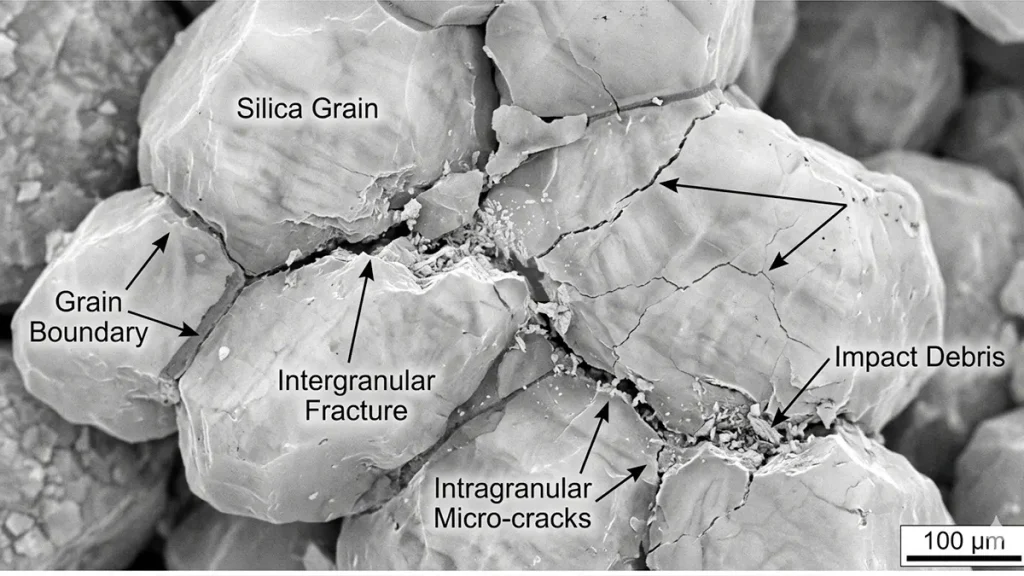
Parameters 3 & 4: Eccentric Throw (Stroke) and Rotational Velocity (RPM)
Raw kinetic energy must be applied with extreme precision. The eccentric throw determines the distance the mantle travels during one rotation. A larger eccentric throw provides greater volumetric capacity, allowing more rock to enter the parallel zone. However, if this throw is mathematically mismatched with a tight CSS, the 200 MPa rock will not compress; it will induce “ring bounce,” instantly shattering the eccentric copper bushing.
Rotational velocity (RPM) operates in tandem with the throw. Operating an HPT series cone at a precise 800 rpm ensures the rock receives 2 to 3 distinct compressive stress wave impacts in the parallel zone before gravity clears it. Slower speeds allow the rock to pass through with only one impact, generating elongated, out-of-spec shinters and skyrocketing the expenditure per shift due to rejected material.
Parameters 5 & 6: Cavity Profile and Nip Angle Geometry
Forcing oversized rock into a mismatched cavity profile is a fatal physics violation.
| Cavity Profile | Recommended Model | Max Feed (mm) | Power (kW) | Optimal Application |
|---|---|---|---|---|
| Coarse (C1/C2) | HPT300 (C) | 230 | 250 | Primary-to-Secondary Transition |
| Medium (M) | HPT300 (M) | 160 | 250 | Standard Aggregate Sizing |
| Fine (F1/F2) | HPT300 (F) | 100 | 250 | Strict Laminated Shaping |
| Extra Fine (EF) | HPT100 (EF) | 45 | 90 | Pre-Sand Making Lamination |
The cavity profile selected from the matrix above directly dictates the nip angle. The nip angle is the geometric wedge between the mantle and bowl liner. If the chosen cavity profile creates a nip angle exceeding 22 degrees, the kinetic friction fails to grip 180 MPa basalt. The material simply “boils” and slips upward, vaporizing the manganese mantle in hours and destroying the production-to-cost ratio.
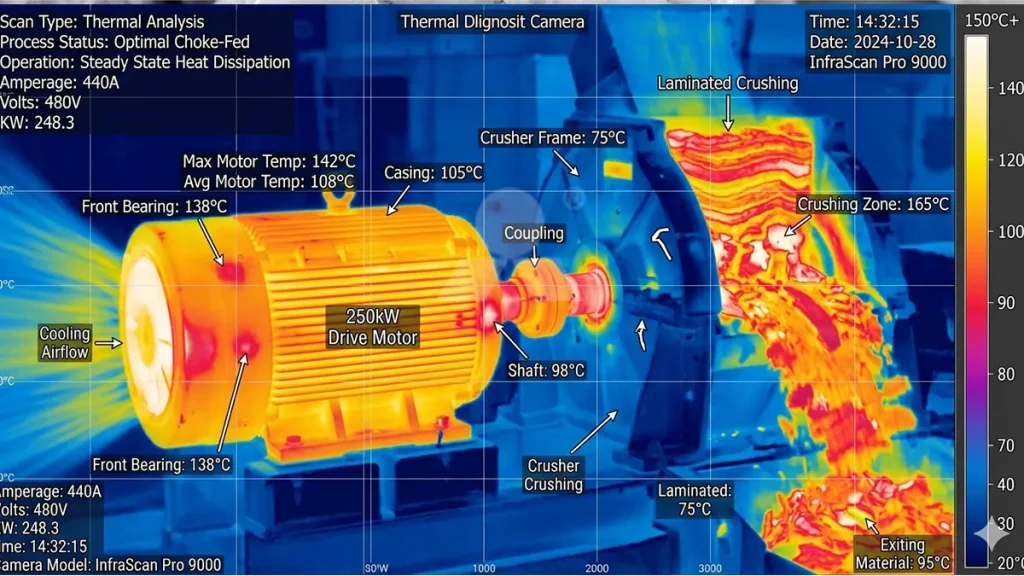
Parameter 7: Motor Power (kW) and Volumetric Limits
Motor power is the final arbiter of kinetic capability. Installing a 250 kW drive on an HPT300 is not arbitrary; it is the exact wattage required to overcome the crushing resistance of 440 tph of dense silica without stalling the eccentric rotation. If the power drops, the crushing force cannot penetrate the mineral grain boundaries. The rock stops breaking, the chamber fills, and the machine suffers a fatal “choke stall.”
200MPa Granite Schematic: Parameter Synchronization Thresholds
- CSS to Throw Ratio: Must maintain volumetric harmony
- Rotational Velocity: 800 rpm sustained under peak load
- Nip Angle Absolute Limit: < 22 degrees to prevent rock boiling
- Power Transfer Efficiency: 250 kW constant draw via V-belt tension
- Laminated Bed Density: Achieved strictly via 100% choke feeding
Technical Index: LH-7 KEY TECHNICAL PARAMETERS OF CONE CRUSHER-SEP/2026-Ref-#11942
Enforce Kinematic Parameters to Arrest Cavity Fatigue
The 7 Key Technical Parameters Of Cone Crusher are the unyielding laws of material science applied to heavy industry. If you treat the CSS, RPM, and nip angle as flexible guidelines rather than strict physical thresholds, your equipment will violently self-destruct. Next month, continuing to feed 200 MPa hard rock into a geometrically misaligned cavity will shatter your eccentric copper bushing and obliterate your hardware amortization cycle. Stop guessing and calibrate the physics.
Calibrate Cavity Geometry and Arrest Eccentric Seizure
“What is the exact eccentric throw paired with your current CSS? Send us your manganese wear profiles, and let’s calculate your true kinetic efficiency.” — From the Desk of your The Material Scientist
Audit Your Kinematic Parameters