

Based on 500 hours of site data from a high-silica river rock circuit in Southeast Asia, the biggest threat to a plant’s profitability isn’t the upfront equipment price—it is the hidden wear on secondary crushing stages and the resulting poor grain shape. When analyzing the core layout, the primary focus must shift from theoretical output to practical continuous gradation. For river pebbles, a misaligned configuration generates excessive flakiness, crippling your finished sand premium capacity. To extract maximum value from abrasive feed, we engineer these circuits using a strict “crush more, grind less” logic, effectively insulating the operation against volatile wear part expenditures.
Mechanical Physics of Lamination Crushing on Abrasive Quartz
Lamination crushing in the secondary stage is the only viable defense against the brutal 200MPa hardness of raw river pebbles.
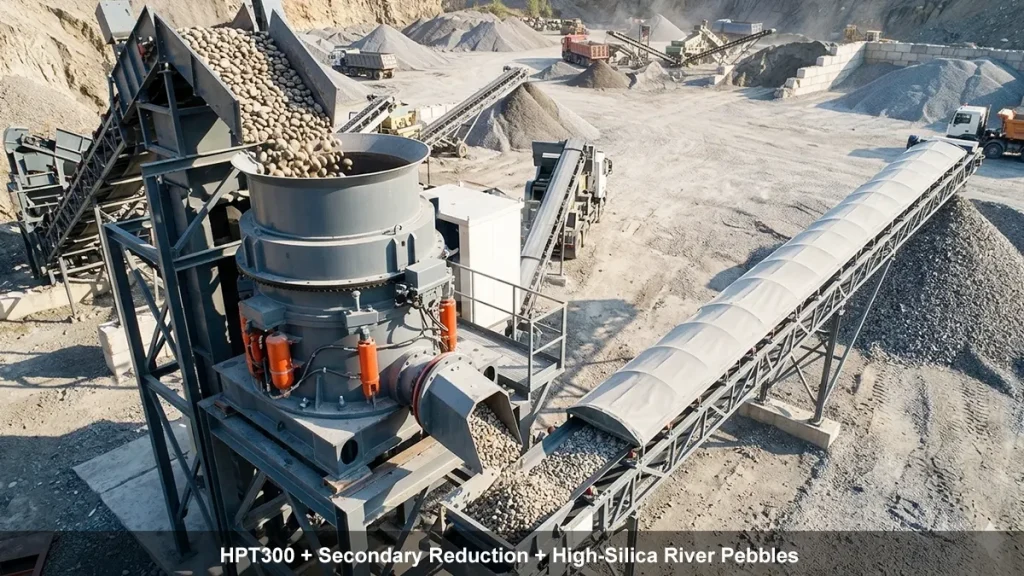
Attempting to impact-crush raw river rock immediately after the primary jaw is an engineering miscalculation that destroys blow bars in under 48 hours. The physics dictate a different approach. We route the 150mm output from the C6X primary jaw directly into an HPT Cone Crusher. The microscopic tolerances of the HPT’s eccentric shaft and its hydraulic tramp release allow it to handle extreme compressive forces. By forcing the rocks to crush against each other in the cavity—true lamination crushing—we drastically cut the expenditure per shift on manganese liners.
The friction generated in this stage is immense. You can physically smell the sharp scent of heated hydraulic oil working to maintain main shaft stability under maximum load. This synchronized pressure reduces the workload on the tertiary sand-making stage, maintaining high mechanical efficiency across the entire plant layout.
The 200-300tph River Rock Architectural Blueprint
A profitable aggregate circuit requires exact synchronization between primary reduction, secondary shaping, and multi-deck screening.
To handle the abrasive silica of river rock at a sustained 250-300 tons per hour, we have engineered the following circuit based on hard metallurgical data. This configuration minimizes the circulating load while protecting the finer meshes of the screening plant.
| Process Stage | Recommended Model | Capacity (tons per hour) | Power (kilowatts) | Max Feed (millimeters) |
|---|---|---|---|---|
| Primary Crushing | C6X100 Jaw Crusher | 130-420 | 110 | 630 |
| Secondary Crushing | HPT300 Cone Crusher | 110-440 | 250 | 230 |
| Sand Making & Shaping | VSI6X9026 Sand Maker | 167-323 | 132~2 | 35 |
| Gradation Screening | S5X2160-3 Vibrating Screen | 85-700 | 30 | 200 |
Mastering Fineness Modulus via the Rock-on-Rock Principle
Achieving a consistent 2.6-3.0 Fineness Modulus requires kinetic energy transfer within the rotor chamber, not just sheer mechanical force.
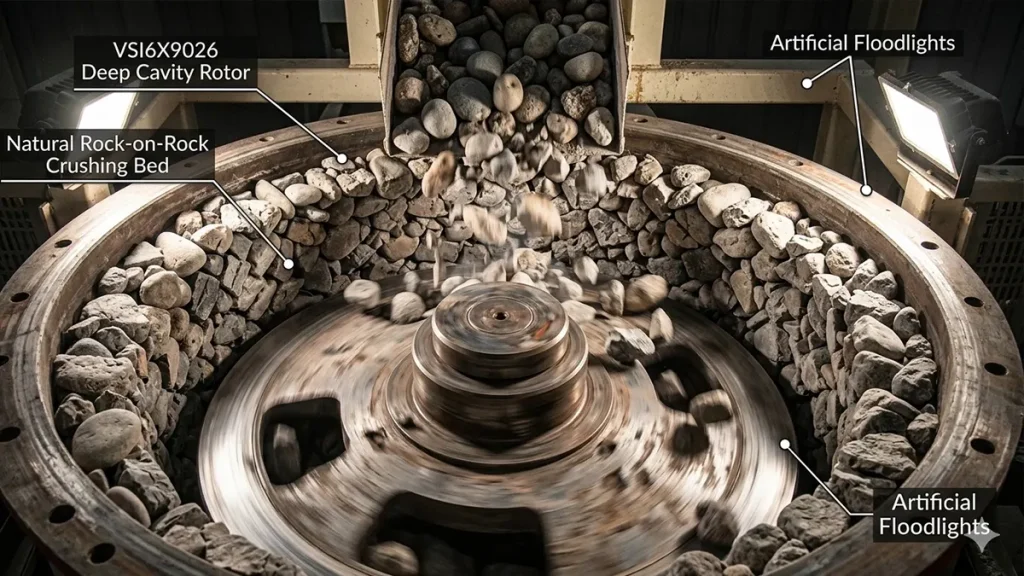
When the 35mm intermediate feed drops from the HPT300 into the VSI6X9026, we apply the “rock-on-rock” principle. The material is accelerated to immense velocities by the dual 132kW motors, colliding with the material bed lining the crushing chamber. This kinetic interaction fractures the stone along its natural cleavage planes. The result is a highly cubic grain shape with excellent continuous gradation.
Standing on the catwalk next to the VSI6X, the vibration felt through your boots changes dramatically if the feed becomes too dry or uneven. Strict powder content control is mandatory here. By precisely managing the rotor speed and the cascade feed ratio, we eliminate excessive micro-fines, guaranteeing the output meets the stringent demands of high-grade commercial concrete mixing plants.
Securing Environmental Integrity in High-Velocity Circuits
A fully enclosed material flow combined with pulse dust collection eliminates aerodynamic powder loss and secures compliance.
The operational cost per ton spikes if local environmental authorities shut down the plant due to particulate emissions. The intense kinetic energy inside the VSI6X generates significant aerodynamic pressure. We counteract this by engineering a negative pressure environment using pulse dust collectors at key transfer points.
We seal the B6X belt conveyors transporting the manufactured sand to the S5X2160-3 vibrating screen. This stops the wind from stripping away the valuable fines required to maintain the 2.6-3.0 Fineness Modulus. A balanced circulating load prevents the screens from blinding, ensuring that oversized particles are cleanly routed back to the VSI without generating secondary dust plumes.
System Verification: Synchronizing VSI6X9026 with S5X Screening
- Fineness Modulus Target: 2.6-3.0
- S5X2160-3 Screen Power: 30 kilowatts
- C6X100 Primary Capacity: 130-420 tons per hour
- HPT300 Secondary Power: 250 kilowatts
- VSI6X9026 Max Feed: 35 millimeters
Technical Index: LH-ADVANTAGES OF THE RIVER SAND PRODUCTION LINE-April/2026-Ref-#48219
Site Architect’s Log: Balancing VSI6X Circulating Loads in High-Silica Circuits
- Why does the VSI6X amperage spike erratically during the afternoon shift?
- Based on telemetry from the S5X screen, erratic amperage indicates an overloaded circulating load. When the HPT300’s closed side setting drifts wider than specified, oversized material floods the VSI6X, forcing the dual 132kW motors to do secondary crushing work instead of tertiary shaping. You must recalibrate the cone.
- How do we stabilize the Fineness Modulus when the raw river pebble moisture content changes?
- Historically, wet feed turns fine dust into a sticky industrial paste inside the rotor. You must adjust the cascade feed ratio on the VSI6X. By increasing the center feed proportion and reducing the waterfall bypass, you increase kinetic collisions, which helps dry out and shatter the cohesive fines before they blind the screen.
- What causes premature wear on the VSI6X distributor plate?
- If you ignore the 35mm maximum feed constraint, you will destroy the plate. Pushing 45mm elongated rocks from the cone directly into the rotor throws the entire kinetic dynamic off balance. The rock-on-rock principle only functions optimally when the feed size is strictly controlled by the preceding screening stage.
- How can we improve powder content control without adding wet washing systems?
- The data shows that relying entirely on the pulse dust collector’s negative pressure can pull too many fines out of the final product. By installing variable frequency drives on the induced draft fan, you can fine-tune the aerodynamic pull, keeping just enough stone dust to maintain the critical 2.6-3.0 Fineness Modulus.
Enforcing Continuous Gradation in High-Volume River Rock Circuits
Optimizing the exact physical relationship between the HPT300’s lamination crushing pressure and the VSI6X’s kinetic rock-on-rock collision is the only way to dictate market pricing. If you fail to lock the Fineness Modulus tightly between the 2.6-3.0 threshold by accurately balancing your circulating load across the S5X screen, the excess flakiness and erratic powder content will cause your next batch of aggregate to be rejected by commercial concrete buyers next month. Enforce the structural discipline of the “crush more, grind less” layout; it protects the 132kW VSI motors from oversized shock loads and permanently upgrades your finished sand premium capacity.
Secure Your 300tph Infrastructure Viability
“Stop Guessing on Rotor Wear Cycles” — From the Desk of your Solution Architect