

Method 1: Correct Asymmetrical Feed Distribution
A twisted chassis cannot classify rock.
Walk up to your S5X1860 platform and look at the feed chute. If the aggregate is dumping off-center, you have already failed. Dumping aggregate to one side forces 80% of the material to travel down a single track of the deck. This asymmetrical load physically twists the steel chassis under dynamic operation.
Half the mesh remains completely empty, while the overloaded side instantly blinds.
When the material bed is too thick, the kinetic throw of the screen cannot lift the rock. The 0-10mm fines are trapped under the oversized boulders and ride the entire length of the deck, falling into the reject chute. You must redesign the feed box. Install a spreader plate or a deflector to fan the material evenly across the entire 1800mm width of the deck before it hits the first mesh panel.
Method 2: Calibrate Eccentric Counterweights
If the rock is merely sliding down the mesh like water down a slide, the kinetic throw is too weak. The material must “dance.” It needs to be violently thrown into the air, allowing the smaller particles to fall through the void spaces of the larger rocks before they hit the mesh again.
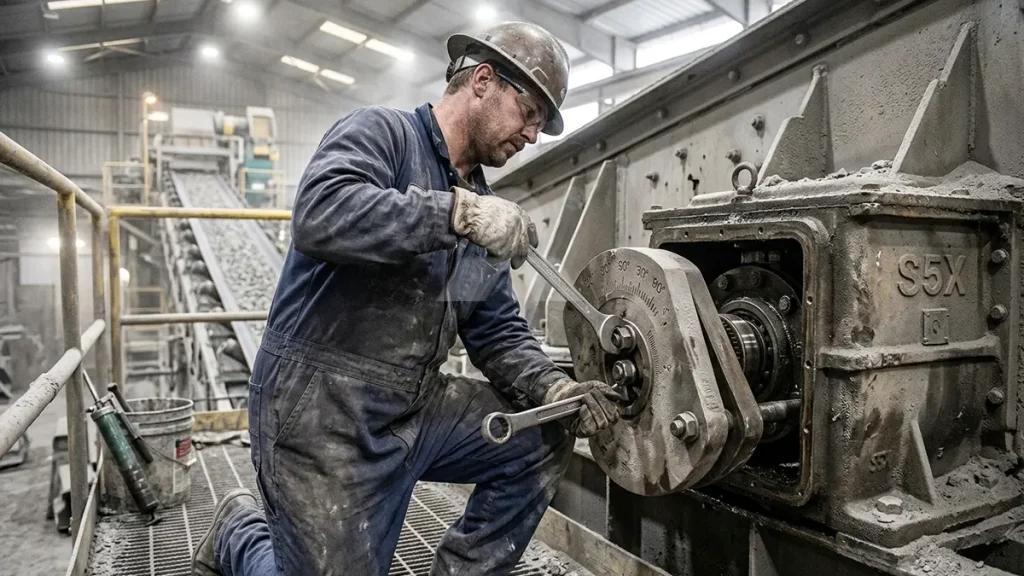
Mechanics must physically open the exciter box.
You adjust the counterweights to increase the amplitude (stroke). By adding weight or altering the phase angle of the eccentric blocks, you increase the violent vertical lift. This forces the 0-10mm fines to violently separate from the oversized rock. However, you cannot guess this parameter. If you add too much weight, you will snap the drive shaft or crack the side plates. You must calibrate the amplitude to match the exact density and depth of your material bed.
Mechanical calibration requires matching the exciter’s force to the specific material load.
| Screen Series | Max Capacity (t/h) | Motor Power (kW) | Kinetic Adjustment Action |
|---|---|---|---|
| S5X1860-3 | 75 – 600 | 30 | Phase angle rotation on exciter |
| S5X2460-3 | 100 – 800 | 30 | Counterweight mass addition |
| S5X3075-3T | 180 – 1800 | 30 × 2 | Dual-drive synchronization |
Notice the dual-drive 30×2 kW power on the S5X3075-3T. When you are pushing 1800 tons per hour, the kinetic force required to lift that mass bed is immense. The counterweights on both exciters must be perfectly synchronized, or the machine will tear itself apart.
Method 3: Steepen the Inclination Angle
Running a circular vibrating screen at a flat 15-degree angle on high-moisture feed stalls the material flow. Wet rock and clay act like glue. If the chassis is too flat, the kinetic energy is absorbed by the mud, and the material bed thickens until the screen completely blinds.
Field Note: I shut down a line in Indonesia where the operator was beating the screen deck with a sledgehammer to clear wet clay. We jacked the chassis inclination up from 15 to 20 degrees. The gravity acceleration broke the clay bridge, and the screen cleared itself in three minutes.
Jacking the chassis inclination up to 18 or 20 degrees utilizes gravity to accelerate the material bed. The rock moves faster across the deck, thinning the material layer. A thinner bed allows the kinetic throw to easily penetrate the mass, preventing wet clay from creating an impenetrable bridge across the apertures.
S5X1860 High-Moisture Feed: Kinetic Calibration Logs
- Chassis Inclination: Shifted from 15° to 19.5° to combat clay bridging
- Bed Depth: Reduced from 150mm to 75mm via gravity acceleration
- Amplitude Stroke: Increased to 9mm to eject pegged silica
- Motor Draw: 30kW maintaining constant RPM under wet load
- Efficiency Gain: Fines recovery increased from 42% to 88%
LH-5_METHODS_TO_IMPROVE_VIBRATING_SCREEN_SCREENING_EFFICIENCY-August/2026-Ref-#81924
Method 4 & 5: Polyurethane Upgrades and Hydro-Washing
If you are running high-silica rock or river pebbles on standard square woven wire mesh, you are begging for downtime. Sharp silica will “peg”—meaning it physically wedges into the square holes. Once a rock pegs, it blocks that hole forever. You must switch to polyurethane screen panels.
Polyurethane is flexible and features tapered (cone-shaped) apertures.
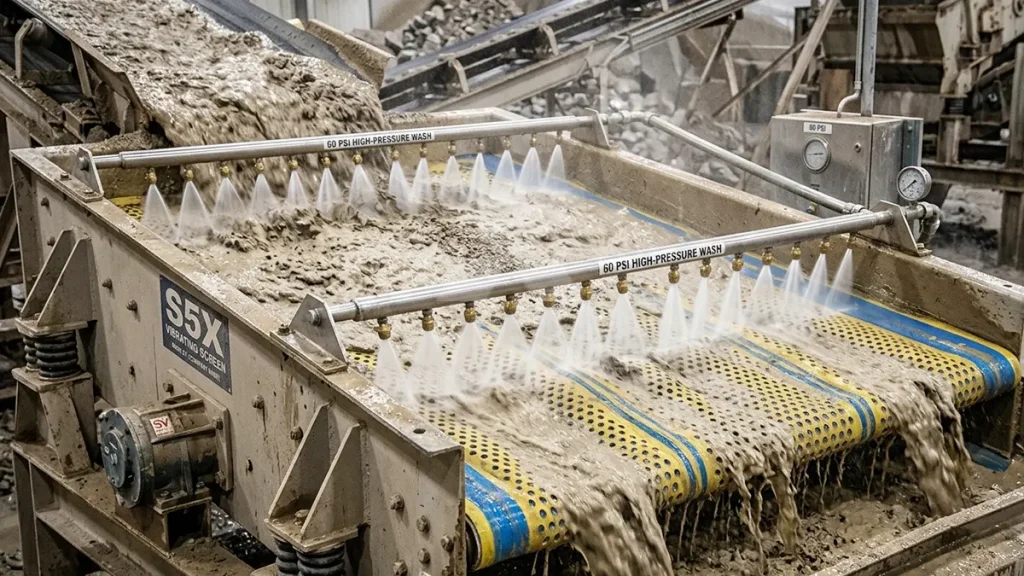
When a rock tries to wedge into a polyurethane hole, the kinetic vibration flexes the plastic, physically ejecting the stone. If pegging is solved but you are still fighting mud (feed containing over 5% clay), mechanical vibration is no longer enough. You must deploy Method 5: Hydro-Washing. Adding a 60 PSI high-pressure spray bar directly above the deck is the only way to chemically and physically break the clay bonds and wash the fines through the mesh into the catch flume.
Terminate the Recirculating Hemorrhage
A blinding screen is not an excuse to grab a sledgehammer; it is a demand for kinetic calibration. If you allow off-center feeding to twist your chassis, or if you refuse to adjust the eccentric weights to match your bed depth, you are intentionally sabotaging your yield velocity. Pushing wet clay across a flat, woven-wire deck next month will result in a 40% efficiency drop, burying your secondary crushers in recirculating overload and causing a catastrophic labor hemorrhage.
Open the exciter box, steepen the angle, and fix the physics of your screen.