

Processing highly abrasive materials like iron ore is one of the most demanding tasks in the mining sector. Hard iron ore wears down inferior equipment rapidly, leading to skyrocketing replacement costs, frequent maintenance, and severe production downtime. If you are a quarry owner or mining engineer optimizing your production line, you must understand exactly how does iron ore cone crusher work to tackle these tough materials effectively and profitably.
Liming Heavy Industry provides advanced, heavy-duty crushing solutions specifically engineered for the harshest mining environments in Africa, Southeast Asia, and South America. Our industry-leading HST Single Cylinder and HPT Multi-Cylinder Hydraulic Cone Crushers are designed to maximize throughput while significantly reducing the wear and tear associated with crushing high-grade iron ore.
The Core Mechanics: How Does Iron Ore Cone Crusher Work?
Unlike a jaw crusher that operates via a simple reciprocating compression motion, a cone crusher utilizes a complex gyratory motion to crush rock continuously. The fundamental principle relies on the squeezing of the iron ore between a moving piece of steel and a stationary piece of steel.
Here is the step-by-step breakdown of the working principle:
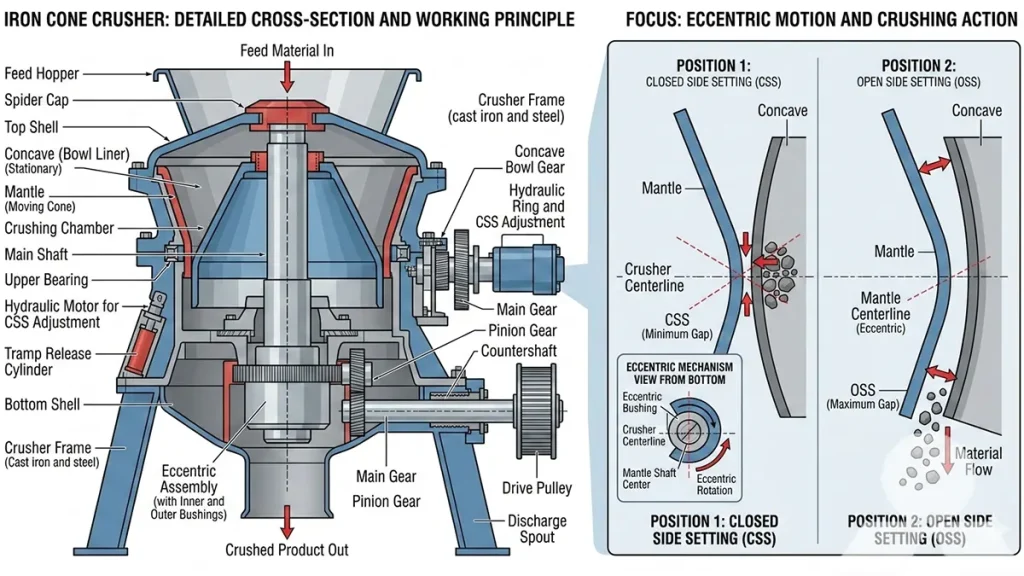
- Power Transmission: The motor drives the horizontal countershaft via V-belts. The countershaft rotates the pinion gear, which in turn drives the large eccentric gear at the base of the machine.
- Gyratory Motion: This eccentric gear forces the main shaft (and the crushing cone attached to it) to swing in a continuous eccentric circle. It does not spin on its axis; rather, it wobbles, much like a spinning top that is slowing down.
- The Crushing Action: As the main shaft gyrates, the outer crushing surface (the Mantle) continuously approaches and then moves away from the fixed inner crushing surface of the frame (the Concave or Bowl Liner).
- Lamination Crushing: When iron ore is fed into the top of the crusher, it falls into the crushing chamber. As the mantle swings toward the concave, the ore is squeezed, fractured, and broken down by massive compressive forces. Because the chamber is full of rock, the stones also crush against each other—a highly efficient process known as lamination crushing.
- Discharge: As the mantle swings away, the gap widens, allowing the crushed iron ore to fall lower into the chamber until it is small enough to exit through the discharge opening at the bottom.
Key Internal Components for Iron Ore Processing
To fully grasp the mechanics, it is essential to understand the heavy-duty components that allow these machines to survive continuous exposure to abrasive iron ore:
- Mantle (Moving Cone): The replaceable wear liner mounted on the main shaft. In Liming crushers, this is cast from high-manganese steel to resist extreme abrasion.
- Concave (Stationary Bowl Liner): The fixed wear liner attached to the upper frame of the crusher.
- Eccentric Assembly: The heart of the machine that creates the wobbling motion, dictating the crushing stroke and speed.
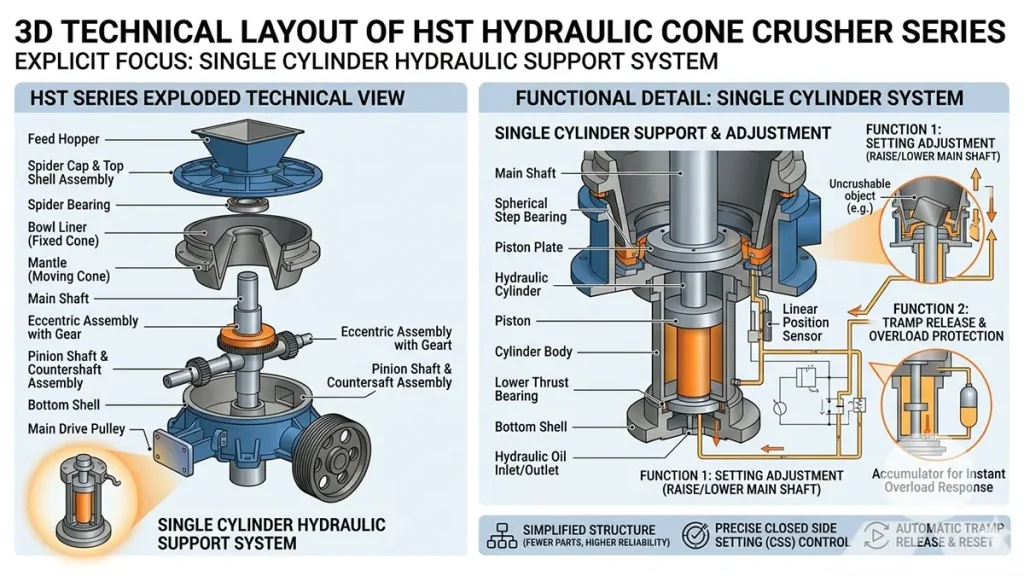
- Hydraulic Cylinder: In modern HST/HPT series, hydraulic cylinders support the main shaft. They allow operators to adjust the discharge opening remotely and provide automatic tramp iron release (if uncrushable metal enters the chamber, the hydraulic system drops the mantle to let it pass safely).
Technical Specifications: Liming HST & HPT Series for Iron Ore
Standard spring cone crushers often struggle with the extreme hardness of iron ore, leading to frequent spring failures and uneven particle sizes. Liming Heavy Industry’s HST (Single Cylinder) and HPT (Multi-Cylinder) hydraulic cone crushers are optimized for secondary and tertiary iron ore crushing. They offer superior crushing ratios, better particle shapes (cubical), and highly automated operation.
Below is a technical comparison of our popular models used in iron ore plants:
| Parameter | HST100 (Single Cylinder) | HPT300 (Multi-Cylinder) |
|---|---|---|
| Application Stage | Secondary / Tertiary Crushing | Secondary / Tertiary Crushing |
| Max Feed Size (mm) | Up to 135 | Up to 230 |
| Capacity Range (t/h) | 45 – 120 | 120 – 450 |
| Motor Power (kW) | 90 | 220 – 250 |
| Adjustment Method | Fully Hydraulic (Bottom cylinder) | Fully Hydraulic (Multi-cylinder) |
| Ideal Ore Type | Medium to Hard Rock / Iron Ore | Extremely Hard / Abrasive Iron Ore |
Frequently Asked Questions (FAQ)
1. Why is a cone crusher better than a jaw crusher for secondary iron ore crushing?
A jaw crusher is ideal for primary crushing to break massive boulders. However, for secondary crushing, a cone crusher provides continuous crushing action, a higher reduction ratio, and produces a finer, more uniform cubical product shape, which is essential for the subsequent grinding (milling) stage in iron ore beneficiation.
2. How often should I replace the mantle and concave when processing iron ore?
Iron ore is highly abrasive. While the exact lifespan depends on the silica content and the feed size, standard high-manganese liners may last anywhere from 200 to 500 operating hours. Liming offers specialized alloy liners that can significantly extend this lifespan, reducing your maintenance downtime.
3. How do hydraulic cone crushers handle uncrushable materials like steel excavator teeth?
Liming’s HST and HPT series feature advanced hydraulic tramp release systems. When uncrushable metal enters the chamber, the hydraulic pressure spikes. The system instantly detects this and lowers the main shaft, widening the discharge gap to let the metal fall through safely, before automatically returning to its original crushing setting.
Understanding how does iron cone crusher work is the first step in optimizing your mining operation. The continuous gyratory motion, combined with lamination crushing and advanced hydraulic protection, makes modern cone crushers the undisputed champions of processing highly abrasive hard rock. By upgrading your secondary and tertiary stages with Liming’s robust technology, you ensure maximum throughput, superior product shape, and significantly lower operating costs.