

Are high transportation costs, complex site setups, and inflexible equipment eating into your quarry or contracting profit margins? For mid-sized mining and aggregate operations, finding the precise 120-150 tph voltas mobile crushing plant configuration and rate is a critical step in project planning. Contractors need machinery that is robust, easy to relocate, and highly cost-effective.
While regional options exist, global contractors are increasingly turning to Liming Heavy Industry for premium mobile crushing solutions. Our advanced wheeled and tracked mobile crushing stations offer unparalleled configuration flexibility, higher crushing efficiency, and a faster return on investment (ROI) compared to standard market alternatives. In this comprehensive guide, we will break down the ideal 120-150 ton-per-hour (TPH) mobile configuration, process flow, and detailed rate analysis to help you make an informed purchasing decision.

Standard 120-150 TPH Mobile Crushing Plant Configuration
A capacity of 120 to 150 tons per hour is considered a “sweet spot” for medium-scale road construction, urban waste recycling, and aggregate production. To achieve this output consistently, a two-stage crushing setup (Primary + Secondary) combined with a screening unit is highly recommended.
1. Primary Crushing Module: Mobile Jaw Crusher
The first stage requires a robust machine capable of handling large feed sizes (up to 500-600mm) such as granite, basalt, or river stone.
- Equipment: Mobile Jaw Crusher (e.g., Liming KE Series or NK Series Jaw)
- Max Feed Size: ~600 mm
- Discharge Size: 65-160 mm
- Function: Coarse crushing of the raw material. Features a vibrating feeder integrated directly onto the chassis to ensure a continuous and even feed rate.
2. Secondary Crushing & Screening Module: Mobile Cone or Impact Crusher
Depending on the hardness of your rock, the secondary stage will shape the final product. For hard rocks (granite, basalt), a Cone Crusher is used. For medium-soft rocks (limestone) or recycling concrete, an Impact Crusher is preferred.
- Equipment (Hard Rock): Mobile Cone Crusher equipped with a multi-deck vibrating screen.
- Equipment (Soft Rock): Mobile Impact Crusher equipped with a multi-deck vibrating screen.
- Screening: A 3-deck or 4-deck vibrating screen to separate the output into standard aggregate sizes (e.g., 0-5mm, 5-10mm, 10-20mm).
- Closed-Circuit System: Oversized material rejected by the screen is automatically fed back into the secondary crusher via a return conveyor.
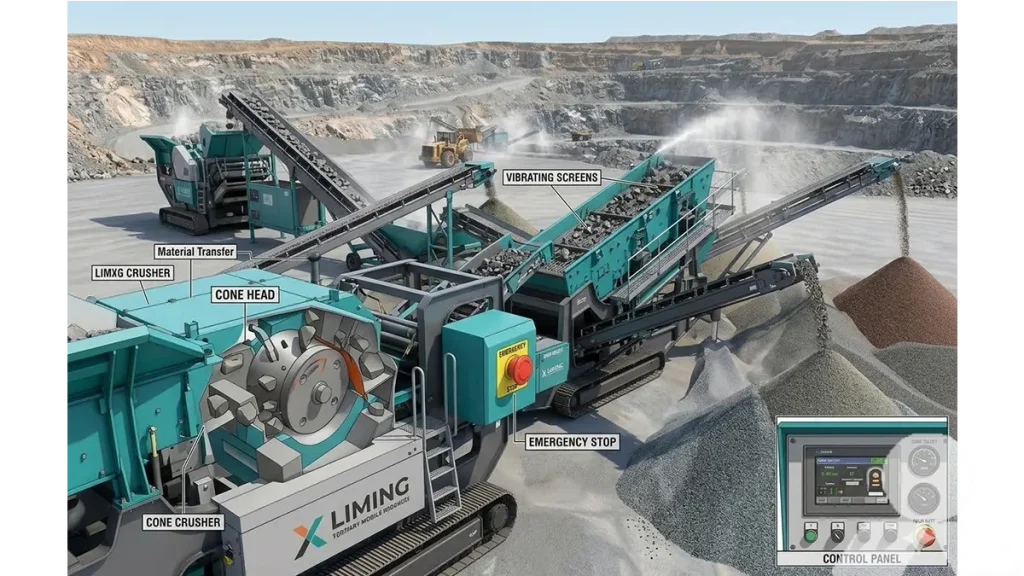
Detailed Equipment Specifications Table
Below is a typical parameter table for a Liming Heavy Industry 120-150 TPH tracked/wheeled mobile configuration, designed to out-perform standard equivalents.
| Module | Machine Type | Recommended Model Capacity | Motor Power (kW) | Transport Weight (t) |
|---|---|---|---|---|
| Primary | Mobile Jaw Crusher | 80 – 200 TPH | ~ 110 kW | 35 – 45 t |
| Secondary (Hard Rock) | Mobile Cone + Screen | 90 – 180 TPH | ~ 160 kW | 40 – 50 t |
| Secondary (Soft Rock) | Mobile Impact + Screen | 100 – 200 TPH | ~ 132 kW | 38 – 48 t |
Process Flow Chart for 120-150 TPH Production Line
Understanding the material flow is vital for optimizing site layout and minimizing operational bottlenecks:
- Feeding: Excavators or wheel loaders dump raw stones into the hopper of the Primary Mobile Jaw Crusher.
- Primary Crushing: The vibrating feeder pushes material into the jaw crusher. Dirt and fine soil are pre-screened and removed via a side conveyor.
- Transport: Crushed coarse material is transported via the main belt conveyor to the Secondary Mobile Crusher.
- Secondary Crushing: The material is crushed into smaller sizes by the Cone or Impact Crusher.
- Screening: The crushed material is fed onto the vibrating screen. Standard sizes are stockpiled via radial conveyors. Oversized rocks are looped back into the secondary crusher.
Analyzing the “Rate”: Price and ROI Analysis
When searching for a 120-150 tph voltas mobile crushing plant configuration and rate, buyers must look beyond the initial capital expenditure (CAPEX) and evaluate the operational expenditure (OPEX) to determine the true ROI.
1. Estimated Initial Capital Investment (The “Rate”)
The price of a 120-150 TPH mobile crushing setup varies based on chassis type (tracked vs. wheeled) and the specific crushers used. Generally, wheeled mobile crushers are more budget-friendly, while tracked (crawler) mobile crushers offer better terrain adaptability but come at a higher premium. By consulting Liming Heavy Industry, clients can receive a tailored factory-direct quotation that eliminates middleman markups.
2. Operational Cost Breakdown
- Power Consumption: Mobile plants can be dual-powered (diesel-electric). Utilizing grid electricity when available significantly reduces the cost per ton compared to running solely on diesel.
- Wear Parts: High-chrome blow bars (for impactors) and high-manganese steel mantles/jaw plates (for cone/jaw crushers) require periodic replacement. Liming’s advanced metallurgy extends wear life by 20-30%.
- Labor: Modern mobile plants feature PLC smart control systems, meaning a 150 TPH plant can often be operated by just 1 or 2 technicians.
3. ROI Projection (Example)
Assuming a production rate of 120 tons/hour, operating 8 hours a day, for 250 days a year, the plant will produce 240,000 tons annually. Even with a conservative profit margin of $3 to $5 per ton of finished aggregate, the plant can generate substantial revenue, often allowing owners to recoup their initial investment within 8 to 14 months, depending on local aggregate market rates.
Why Choose Liming Heavy Industry for Your Mobile Plant?
While regional brands offer basic functionality, Liming Heavy Industry provides a globally supported, technologically advanced alternative:
- Integrated Design: Feeder, crusher, screen, and conveyors are seamlessly integrated onto a single chassis, reducing setup time from weeks to mere days.
- Smart Controls: Advanced hydraulic and electronic control systems allow for easy adjustment of discharge openings and remote monitoring of machine health.
- Global After-Sales Support: With spare parts warehouses and dedicated service engineers across Africa, Southeast Asia, and South America, Liming ensures your downtime is minimized.
Frequently Asked Questions (FAQs)
1. What is the difference between wheeled and tracked mobile crushing plants?
Wheeled mobile crushers require a semi-trailer truck to be towed from site to site and are highly cost-effective for standard quarry setups. Tracked mobile crushers are self-propelled via crawler tracks, making them ideal for rough, uneven terrain and sites that require the machine to move frequently alongside the working face.
2. Can a 120-150 TPH mobile plant process hard rock like granite?
Yes. For abrasive and hard rocks like granite or river pebbles, the configuration must utilize a Jaw Crusher for the primary stage and a Cone Crusher for the secondary stage to prevent excessive wear and tear on machine parts.
3. How do I get an exact price rate for this configuration?
Because every quarry has unique raw materials, output size requirements, and power availability, standard pricing varies. To get a precise rate, provide your material type, max input size, and required output sizes to our engineering team for a customized factory-direct quote.
Investing in a high-quality mobile crushing setup is essential for maximizing efficiency and profitability in today’s competitive aggregate and contracting markets. By understanding the optimal 120-150 tph voltas mobile crushing plant configuration and rate, and comparing it with world-class alternatives from Liming Heavy Industry, you can secure equipment that delivers reliable performance, excellent mobility, and rapid ROI.