

Deconstructing Geological Reality in Quarry Equipment: Types, Applications, and How to Buy the Best Units
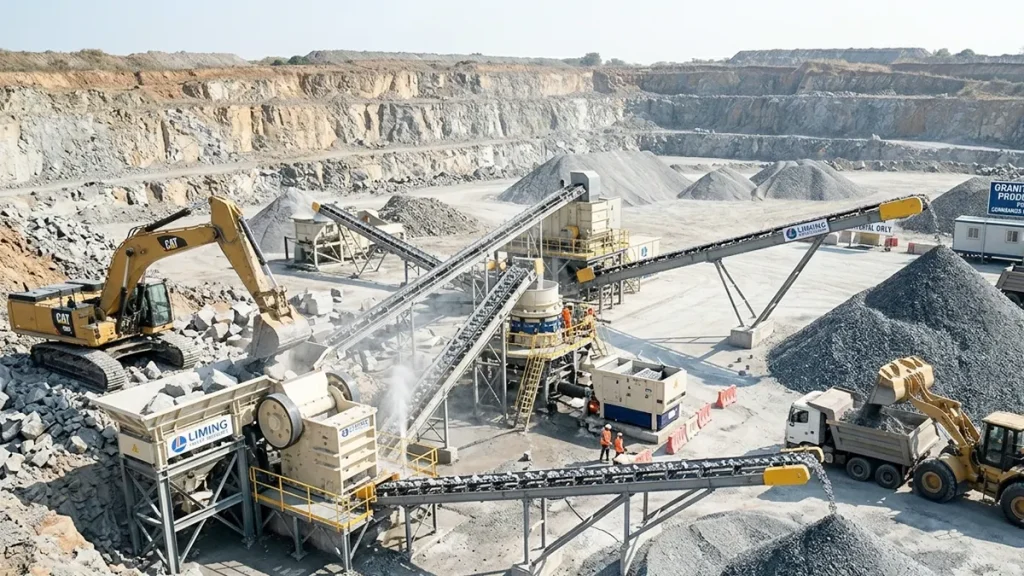
Primary Extraction: The Gatekeepers (Jaw vs. Gyratory)
The first node of your circuit must absorb the highest kinetic violence.
Raw blast rock is chaotic, oversized, and unyielding. The primary stage must ingest this material without stalling. Primary extraction mandates gross compressive reduction. You have two choices. A Gyratory Crusher (like the HGT series) utilizes continuous annular compression to ingest up to 2500 tph directly from 100-ton haul trucks without requiring an intermediate feeder. However, sinking a 20-meter concrete shaft for a gyratory is financially unviable for standard, sub-1000 tph quarries.
This is where the Jaw Crusher dominates.
A C6X Jaw Crusher utilizes intermittent V-cavity compression. It acts as the ultimate, versatile gatekeeper for standard 100-800 tph aggregate plants. It relies on massive leverage and heavy flywheels to shatter 800mm boulders. You cannot bypass the primary stage. If you attempt to feed raw blast rock into a secondary machine, the cavity will bridge instantly, causing a violent thermal stall.
Secondary Reduction: The Hard vs. Soft Rock Mandate
Once the rock is reduced to a manageable 150mm profile, the most critical architectural decision occurs. If your geology is highly abrasive (granite, basalt, quartzite exceeding 150MPa), you must deploy a Cone Crusher. Deploying a premium Impact Crusher (CI5X) on 200MPa high-silica granite is an act of fiscal suicide. The abrasive friction will vaporize the high-chrome blow bars in 48 hours, sending your expenditure per shift into a death spiral.
Hard rock absolutely mandates an HPT Cone Crusher.
Cones utilize slow, high-pressure lamination crushing to survive the abrasive friction, grinding the rock against itself rather than destroying the machine’s steel. Conversely, if your geology is soft, low-silica limestone (<150MPa), a cone crusher will over-pulverize the rock into useless dust. Here, the Impact Crusher reigns supreme. Its kinetic blow bars exploit the soft cleavage planes of limestone, generating a high yield of cubical aggregate in a single pass without over-grinding.
Violating the secondary crushing hierarchy guarantees catastrophic wear-part consumption.
| Crusher Typology | Kinetic Mechanism | Geological Match | Fatal Misapplication |
|---|---|---|---|
| HGT Gyratory | Continuous Compression | Any Rock (> 1000 tph) | Low-tonnage, short-term sites |
| C6X Jaw | Intermittent Cleavage | Any Rock (100 – 800 tph) | Secondary fine crushing |
| HPT Cone | Lamination (High Pressure) | Hard/Abrasive (> 150MPa) | Soft limestone (causes dust) |
| CI5X Impact | Kinetic Blow (High Speed) | Soft/Non-Abrasive (< 150MPa) | Granite (destroys blow bars) |
Observe the stark division in the secondary stage. You must physically test your rock’s compressive strength. The data from the core sample dictates whether you purchase the HPT Cone or the CI5X Impact.
Tertiary Shaping: The VSI Mandate
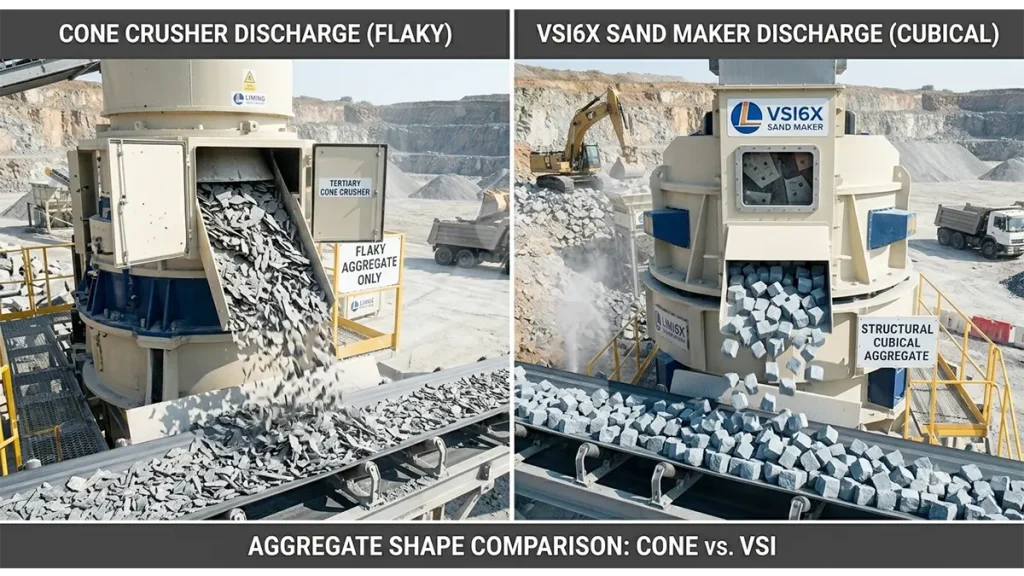
Both Jaws and Cones produce up to 20% flaky aggregate due to their reliance on pure compressive force. If you are selling structural concrete aggregate, this flakiness index will trigger immediate rejection by commercial inspectors. Buying the “best” primary and secondary units means nothing if the architect omits a VSI6X Sand Maker. The VSI (Vertical Shaft Impactor) is the only machine mathematically capable of curing this geometric flaw.
Field Note: I shut down a plant in the Middle East that tried to use a fine-cavity cone as a final shaper. The aggregate failed every shear test. We installed a VSI6X1040, induced rock-on-rock collision, and dropped their flakiness index to <8% overnight.
The VSI6X utilizes high-speed rock-on-rock kinetic collision. It accelerates the flaky stones and smashes them into a stationary bed of rock, physically chipping off the sharp edges. It does not reduce size efficiently; its sole purpose is to yield strict cubical manufactured sand and premium aggregate.
Procurement Audit: Analyzing Mass Flow Metrics
- Geological Core Sample: Absolute prerequisite before issuing a PO.
- Silica Vulnerability Check: >5% silica strictly disqualifies Impact Crushers.
- Closed-Circuit Integration: S5X screens mandatory for zero-waste looping.
- Moisture Dominance Check: Sticky clay mandates primary Grizzly bypass.
- Operational Footprint: Hydraulic VSI integration required for <8% flakiness.
Enforce Circuit Hierarchy Based on Geology
Stop treating crushers as interchangeable commodities. If you deploy an impact crusher on 200MPa granite, or force a cone crusher to process soft limestone next month, the resulting mechanical stalls and wear-part destruction will permanently cripple your metallurgical yield velocity. You must execute a strict hierarchy: Jaws for gross extraction, Cones for abrasive survival, Impactors for soft-rock shaping, and VSI machines for tertiary cubical correction. Align the kinetic mechanism of the machine directly with the physical limitations of your geology.