

Architecting Mass Balance: How to reduce the operating cost of jaw crusher via Systemic Synergy
Isolating a primary crusher from its surrounding material flow inevitably leads to flawed financial diagnostics. During a system evaluation at a high-capacity limestone quarry in Oman this August 2025, the operator was attempting to lower costs by purchasing cheaper, non-OEM manganese jaw dies. The plates were fracturing weekly, and the electrical bills remained exorbitant. The root of the problem was not the metallurgy; it was the architectural layout. The jaw was being suffocated by mud and undersized rock that never should have entered the chamber. Understanding How to reduce the operating cost of jaw crusher demands a macro-level evaluation of mass balance. The most effective way to reduce the expenditure per shift on a primary breaker is to systematically prevent it from crushing material that does not require reduction.
The Physics of Pre-Screening: Scalping “Dead Rock”
A jaw crusher’s kinetic energy must be reserved exclusively for oversized boulders.
Raw material arriving from the blast face is a chaotic mixture of massive boulders, gravel, and dirt. If this raw feed is dumped directly into a jaw crusher, the fine material fills the voids between the larger rocks. As the movable jaw compresses, this trapped dirt and gravel compacts into an incompressible solid. This phenomenon, known as chamber packing, forces the toggle plate to absorb massive, unintended kinetic stress and spikes the motor’s electrical draw.
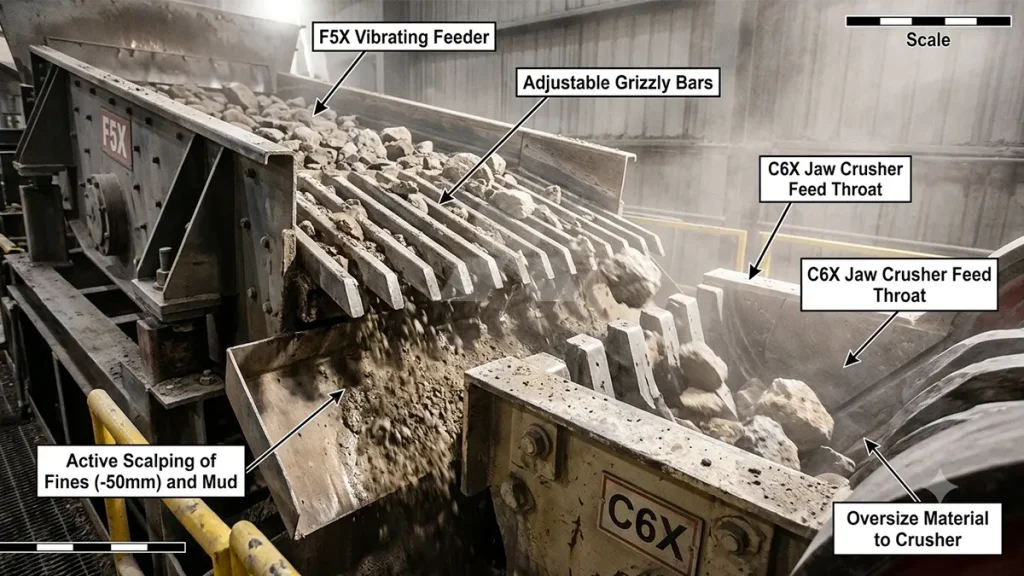
Architects resolve this by deploying an F5X series vibrating feeder equipped with adjustable grizzly bars. The grizzly section acts as a primary scalper, allowing dirt and undersized rock (e.g., -50mm) to fall through a bypass chute, completely avoiding the crushing chamber. Bypassing this “dead rock” drops the primary motor’s amp draw by up to 18%, significantly lowering the daily utility footprint while simultaneously protecting the manganese liners from abrasive friction.
Synchronizing Volumetric Feed Rates
Erratic feeding destroys production-to-cost ratios. When haul trucks dump 40 tons of rock directly into a jaw hopper without a regulated feeder, the crusher experiences a “surge feed.” The chamber instantly fills, the motor high-amp stalls, and the machine struggles to clear the load. Once cleared, the machine runs empty for several minutes until the next truck arrives.
This accordion effect is mathematically inefficient. The massive flywheel of a jaw crusher is designed to maintain kinetic momentum. Surge feeding breaks this momentum, forcing the motor to consume maximum electrical power to re-accelerate the eccentric shaft under load. Synchronizing the feeder speed to the jaw’s continuous volumetric capacity (e.g., tuning the VFD to maintain a steady 350 tph flow) stabilizes the kinetic momentum. A flat, consistent amp draw curve is the ultimate indicator of an optimized primary circuit.
Configuration Matrix: Aligning the Primary Station
Over-sizing the feeder or under-sizing the jaw creates a permanent structural bottleneck.
| Target Production | Recommended Feeder | Primary Jaw Crusher | Motor Power (kW) | Architectural Advantage |
|---|---|---|---|---|
| 150 – 250 tph | TSW1139 | PEW760 | 110 | Lean power draw for medium pits |
| 200 – 500 tph | F5X1260H | C6X100 | 110 | Optimized grizzly scalping surface |
| 300 – 600 tph | F5X1360H | C6X110 | 160 | Heavy-duty surge absorption |
| 500 – 900 tph | F5X1560H | C6X145 | 200 | Maximized volumetric throughput |
Integrating the C6X110 jaw crusher with an identically matched F5X feeder guarantees that the primary station operates as a unified thermodynamic engine, rather than two isolated machines fighting for mass balance.
C6X110 Primary Station: Kinetic & Electrical Thresholds
- Grizzly Bar Spacing: Calibrated to bypass -50mm raw fines
- Kinetic Power Draw: 160 kW (Maintained flat via VFD feeder synchronization)
- V-Belt Tension Variance: Strictly < 2% to prevent invisible power slippage
- CSS Transfer Size: Locked to 150mm to optimize secondary cone efficiency
- Volumetric Flow Target: Sustained 400 tph base load
CSS Calibration and Downstream Transfer Sizing
A common architectural error is attempting to produce overly fine material straight out of the primary jaw. Running a jaw crusher with a Closed Side Setting (CSS) that is too tight forces the machine to execute secondary reduction. A jaw is a compressive fracture tool, not a shaping device. Over-tightening the CSS geometrically restricts the discharge opening, slowing the volumetric descent of the rock and causing extreme, localized friction on the lower third of the manganese plates.
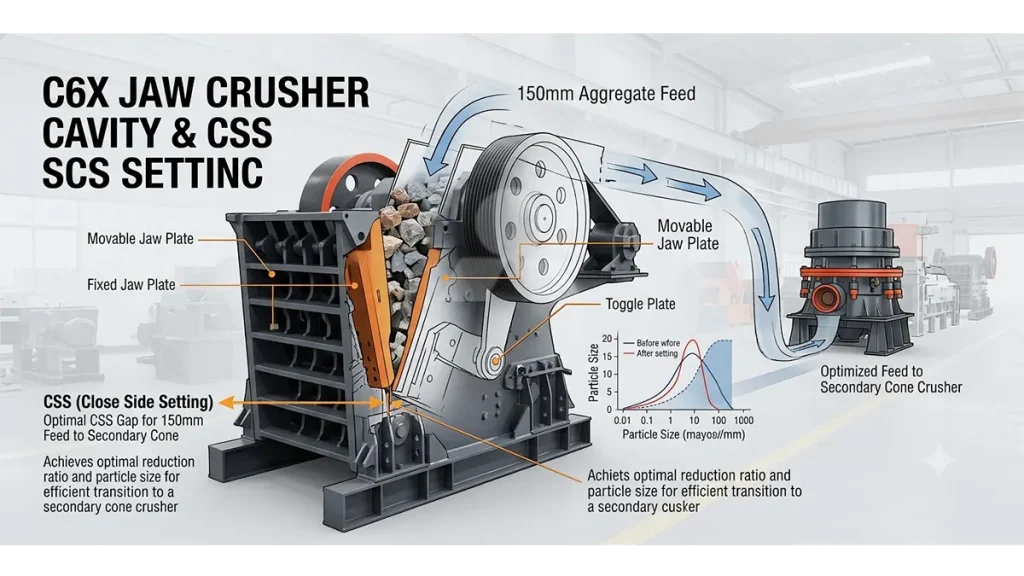
Opening the CSS to the optimal geometrical transfer size (e.g., 150mm for a downstream HPT300 cone) radically increases primary throughput. It shifts the sizing burden to the secondary hydraulic cone crushers, which are specifically engineered for laminated, high-efficiency fine reduction. This macro-level adjustment safeguards the jaw’s hardware amortization cycle.
Systemic Attrition Diagnostics & Volumetric Post-Mortem
- What physical evidence on the jaw plates indicates the feeder is failing to scalp fines?
- I inspected a stationary jaw last quarter; the entire central cavity of the fixed plate was packed with a hardened layer of crushed clay and silica dust. When the grizzly bars fail to bypass dirt, the fines compact under 200 MPa of pressure, creating a concrete-like barrier that forces the motor to fight internal friction rather than fracturing rock.
- Historically, why did operators ignore precise V-belt tensioning?
- Decades ago, basic amp meters lacked the sensitivity to detect micro-slippage. Today, telemetry proves that a mere 5% loss in V-belt tension between the 160 kW motor and the flywheel results in invisible kinetic slippage. The motor consumes full electrical power, but the eccentric shaft loses crushing force, silently destroying the financial margins.
- Do not attempt to extend jaw plate life by welding hard-facing over worn manganese.
- Applying localized heat to high-manganese steel alters its metallurgical temper, making it highly brittle. When struck by a 500mm boulder, the welded section will shatter and drop into the discharge chute. The only mathematically sound way to extend plate life is by physically flipping the reversible jaw dies at exactly 50% wear.
- How does adjusting the toggle plate angle affect the motor’s baseline efficiency?
- Calculating the kinematic vectors demonstrates that the C6X series utilizes an optimized toggle angle to maximize downward stroke trajectory. If an operator alters this geometry using non-OEM toggle seats to artificially change the CSS, the stroke becomes entirely horizontal. This traps the rock, generating massive upward recoil that shatters the main bearing housing.
Enforce Volumetric Discipline to Accelerate Payback
The operational cost of a primary jaw is dictated before the rock ever enters the chamber. Analyzing How to reduce the operating cost of jaw crusher proves that isolating the machine from its volumetric flow guarantees financial attrition. Next month, if your plant continues to dump un-screened fines into the primary cavity or subjects the 160 kW motor to erratic surge feeding, your expenditure per shift will be consumed by wasted electricity and premature manganese failure. Architect a synchronized primary station, calibrate your grizzly scalpers, and secure your capital payback velocity.
Arrest Power Waste and Architect Your Mass Balance
“What is the exact percentage of -50mm fines currently entering your primary chamber? Send us your feeder specifications, and let’s engineer a mathematically synchronized scalping circuit.” — From the Desk of your The Solution Architect
Audit Your Primary Circuit