

I inspected a recycling site last month where the downstream rubber conveyors were deeply gouged and torn. The over-band magnet had lost its suspension height calibration, allowing bent rebar to slip past. Operators must routinely audit the gauss strength and clearance height of the magnet to prevent catastrophic belt puncture.
Transforming urban demolition sites into active aggregate production zones requires specialized architectural configurations. During a site evaluation of an urban renewal project in Berlin this March 2026, the contractor was attempting to process demolished building foundations using a standard jaw-and-cone circuit. Within three hours, a twisted length of 20mm rebar had bridged the secondary cone crusher, resulting in a severe mechanical lockup. Construction and Demolition (C&D) waste is not monolithic rock; it is a highly abrasive composite of high-strength concrete, structural steel, wood, and polymers. Designing an efficient Mobile Crusher for Construction Waste Recycling Plant demands a flow chart that prioritizes material separation just as highly as size reduction. Architects must deploy kinetic impact technology and integrated purification modules to safely convert urban rubble into certified structural aggregate.
The Physics of C&D Fracture: Impactor vs. Cone
Deploying the correct crushing cavity dictates the mechanical survival of the entire recycling circuit.
The primary hazard in processing C&D waste is embedded structural rebar. Feeding reinforced concrete into a cone crusher guarantees catastrophic eccentric shaft seizure. A cone crusher utilizes hydraulic clamping force in a tightly restricted chamber; it will attempt to crush the unyielding steel, transferring immense pressure directly into the main bearing. The architectural mandate for C&D recycling is the mobile impact crusher.
Deploying a crawler-tracked unit like the Vertex VTI1313 utilizes an open-cavity design. The heavy-duty rotor strikes the concrete slab, fracturing the brittle cement matrix while allowing the ductile steel rebar to bend and pass safely through the oversized discharge opening. This kinetic separation frees the metal from the concrete without inducing fatal stress on the crusher’s drive shaft, establishing a reliable volumetric flow.
Metallurgical Purification: The Over-Band Magnet
Recycled concrete is commercially useless if it remains contaminated with steel. Utilizing iron-laced aggregate in new road bases violates strict civil engineering codes and risks severe structural oxidation over time. The purification process must be automated directly on the mobile chassis.
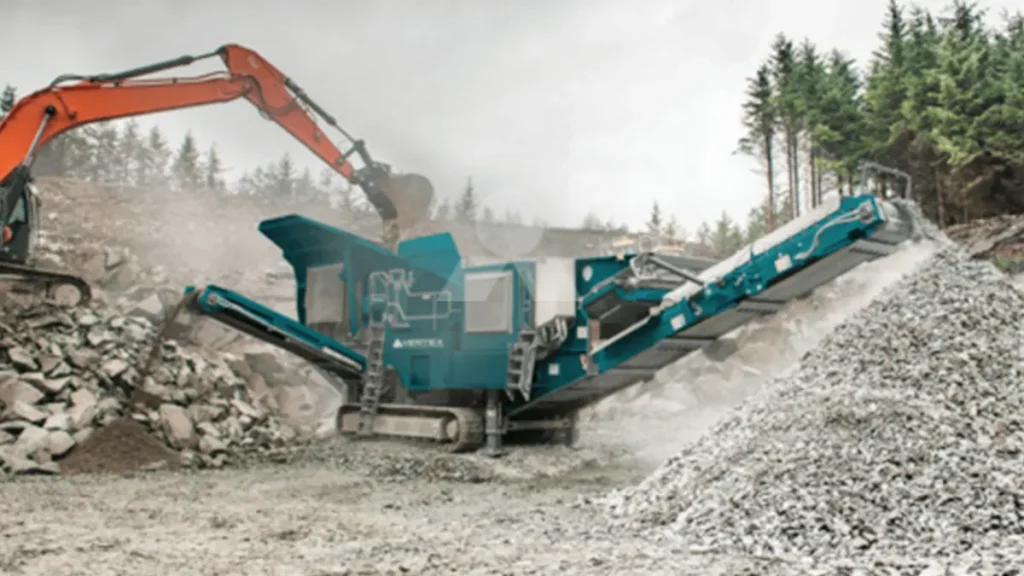
The over-band magnetic separator is suspended precisely above the trajectory of the crushed material leaving the impactor. As the aggregate flattens out on the discharge belt, the high-gauss electromagnet pulls the liberated rebar upwards. A continuous rubber belt on the magnet sweeps the steel laterally, dropping it into a designated scrap bin. This continuous purification stabilizes the production-to-cost ratio by ensuring the final aggregate is 100% compliant with commercial grading standards.
Synchronized Configuration Matrix for C&D Recycling
A flow chart is merely theoretical until supported by precise, multi-stage separation hardware.
| Process Stage | Recommended Equipment | Capacity (tph) | Power (kW) | Architectural Mission |
|---|---|---|---|---|
| Primary Fracture & Separation | VTI1313 Tracked Impactor | 180-240 | 180 | Shatter concrete, liberate rebar |
| Metallurgical Extraction | Over-Band Magnet | Matched | Hydraulic | Extract 98% of ferrous metals |
| Closed-Circuit Grading | VTS-F5015 Tracked Screen | 500-700 | 45 | Ensure strict 0-20mm road-base size |
| Light Material Sorting | Air Classification Module | Matched | Electric Blower | Remove wood, plastic, and insulation |
To guarantee a consistent 0-20mm aggregate suitable for new infrastructure, the tracked plant must operate in a closed-circuit loop. The VTS-F5015 mobile screen acts as the absolute gatekeeper, returning any +20mm concrete chunks back to the impactor. This mathematical mass balance is non-negotiable for producing certified structural fill.
200 TPH C&D Recycling Circuit: Mass Balance Thresholds
- Primary Fracture: 180 kW Impactor handling <800mm reinforced concrete
- Ferrous Extraction Rate: >98% efficiency via automated cross-belt magnet
- Recirculating Load Limit: 20-25% oversize returned to the impactor
- Contaminant Removal: Air blowers active to eliminate <1% plastic/wood by weight
- Output Specification: Strict 0-20mm and 20-40mm recycled aggregate fractions
Light Material Separation: Meeting Engineering Codes
While the magnetic separator handles ferrous metals, C&D waste naturally contains lightweight contaminants like wood splinters, plastic piping, and insulation foam. If these lightweight impurities are mixed into the final road base, they will decompose over time, creating subterranean voids that lead to asphalt subsidence and pavement cracking.
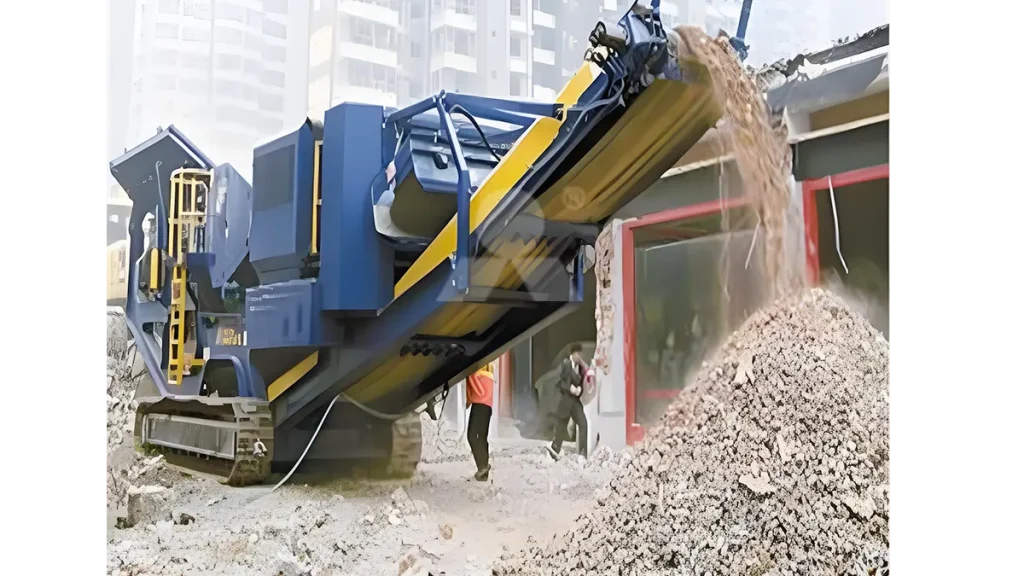
Architects resolve this by integrating air classification modules directly onto the discharge points of the mobile screen. This dry-separation technique ensures that the recycled aggregate maintains a homogeneous, high-density profile. Producing highly purified recycled aggregate fundamentally alters the hardware amortization cycle, allowing operators to command premium market prices for their output rather than paying landfill tipping fees.
C&D Flow Diagnostics & Contamination Post-Mortem
A decade ago, mobile plants were just standard rock crushers mounted on tracks. They lacked integrated magnets and air sifting modules. The resulting output was a contaminated mixture of concrete, steel, and wood that could only be used as low-grade backfill. Modern architectural configurations isolate these materials instantly.
Concrete contains highly abrasive silica sand and cement paste. While the impactor is the correct mechanical choice for handling rebar, the abrasive nature of the cement matrix will wear the blow bars significantly faster than standard soft rock. Maintenance teams must track this specific wear curve to manage the expenditure per shift.
Calculating the logistics proves that an open-circuit plant produces oversized chunks that must be gathered by a loader and manually re-fed into the hopper. A closed-circuit mobile screen automates this return via an integrated conveyor, maintaining absolute mass balance without requiring additional heavy equipment or labor.
Enforce Separation Architecture to Secure Compliance
An urban recycling facility must be architected as a precision sorting and sizing engine. Deploying a Mobile Crusher for Construction Waste Recycling Plant requires utilizing open-cavity impactors and automated purification modules to separate composite waste safely. If you attempt to process reinforced concrete with a cone crusher or fail to extract lightweight contaminants, your aggregate will fail structural testing, destroying your capital payback velocity. Align your flow chart with the physical realities of C&D waste, enforce closed-circuit grading, and secure your product’s market viability immediately.