

As a process design engineer at Liming Heavy Industry, I review dozens of plant layouts every month. One of the most common mistakes I see from new quarry operators involves river pebbles. Because these stones are smooth and naturally rounded by water, people assume they are easy to break. The reality is the exact opposite.
River pebbles are incredibly dense and packed with silica. They are essentially nature’s sandpaper. If you use the wrong machines, the extreme abrasion will eat through your metal wear parts in a matter of days. Your plant will be shut down for repairs more often than it is running, which destroys your daily profit margins.
When designing 200tph river pebble sand making equipment, the golden rule is simple: never use an impact crusher. The silica will destroy the blow bars instantly. Instead, we must rely on the principle of compression and rock-on-rock crushing. Below is the exact machinery layout I design for our clients to guarantee 200 tons per hour of premium manufactured sand.
Stage 1: Primary Crushing
Even though river pebbles are usually smaller than blasted mountain rock, you still need a robust primary stage to handle the oversized cobbles scooped up by the excavators. For a 200tph target, I specify the C6X100 Jaw Crusher.
The C6X100 is engineered for hard rock. It has a heavy-duty frame and an optimal bite angle that grabs the smooth river stones without them slipping out. We feed the raw pebbles into this jaw, which crushes the larger stones down to a manageable size, usually below 150mm. This prepares a steady, consistent feed for the next stage.
Stage 2: Secondary Crushing (The Workhorse)
This is where the real work happens. Because we are dealing with high abrasion, we use a cone crusher. A cone crushes rock by squeezing it between a moving mantle and a stationary bowl liner. Since there is no high-speed impact, the metal wear is drastically reduced.
For this specific capacity, the HPT300 Multi-Cylinder Hydraulic Cone Crusher is my go-to choice. We route the material from the jaw crusher into the HPT300. This machine applies immense hydraulic pressure to shatter the hard pebbles down to under 40mm. The multi-cylinder design allows us to keep the crushing cavity full at all times. We call this “choke feeding,” and it forces the pebbles to crush against each other, which saves the metal liners and improves the shape of the stones.
Stage 3: Sand Making and Shaping
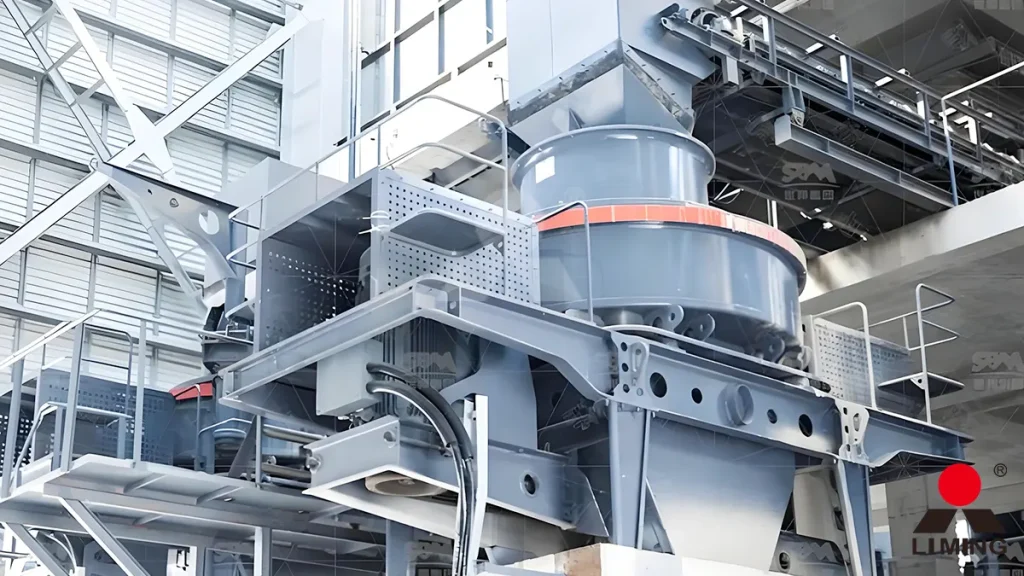
A cone crusher is highly efficient, but it naturally produces some flat and elongated stones. Concrete batching plants will reject sand if the shape is poor. To hit that strict concrete-grade standard, the material must go through a Vertical Shaft Impactor (VSI).
To handle a 200tph flow and generate maximum sand yield, I integrate the VSI6X9026 Sand Maker. This is the crown jewel of our sand production line at Liming Heavy Industry. It uses a brilliant “rock-on-rock” crushing principle. Inside the rotor, the stones are hurled at massive speeds against a bed of other stones lining the chamber. The pebbles shatter themselves. Because the rocks are hitting other rocks instead of hitting metal anvils, the wear costs drop to almost nothing. The VSI6X9026 cuts off the sharp edges and produces a beautifully rounded, cubical manufactured sand (0-5mm) that rivals natural river sand.
Stage 4: Precision Screening
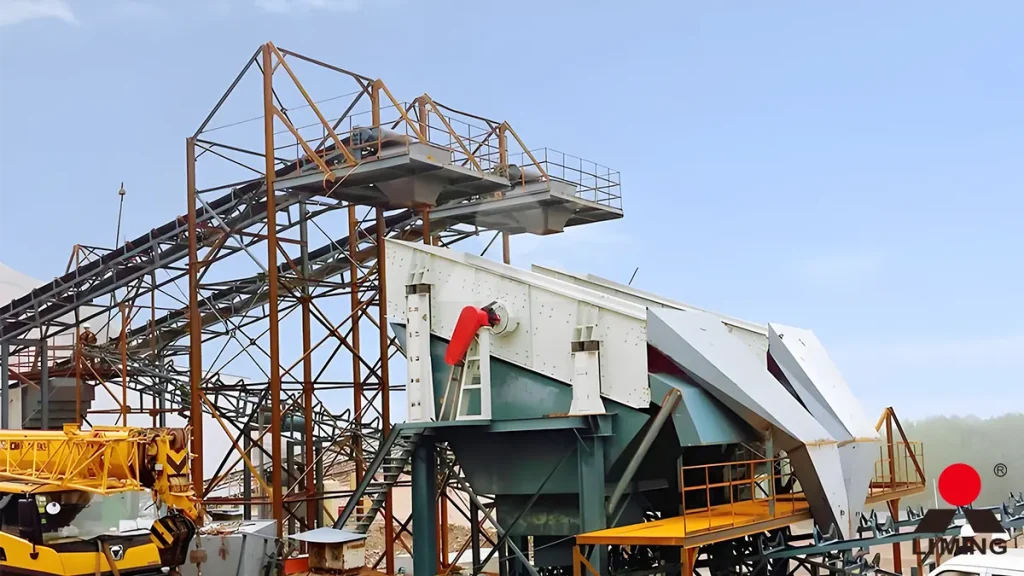
You cannot produce accurate sand sizes without a strict screening loop. I pair the entire system with an S5X2160-3 Vibrating Screen. This is a three-deck screen that acts as the traffic controller of the plant.
Any crushed stone larger than 20mm sitting on the top deck is sent straight back to the VSI6X9026 via a return belt for a second round of crushing. The middle decks sort out the 5-10mm and 10-20mm gravel, which you can sell as construction aggregate. The bottom deck allows the perfect 0-5mm manufactured sand to fall through to the final stockpile.
Engineer’s Final Word
Designing a reliable layout is about respecting the material. River pebbles will punish any weak link in your production line. By using the C6X100 Jaw, the HPT300 Cone, and the VSI6X9026 Sand Maker, you are building a closed-circuit system that absorbs the heavy abrasion while maintaining a steady 200 tons per hour. This configuration keeps your daily maintenance bills down and ensures your final sand product commands the highest price in the local construction market.