

Configuring a primary crushing circuit for bauxite requires understanding the vast geological differences between soft gibbsite and hard diaspore ores. This engineering guide details the optimal jaw crusher configuration for bauxite aluminum ore processing. Written by a senior metallurgical engineer, the article explains how to deploy Liming Heavy Industry’s heavy-duty PE and C6X Jaw Crushers to handle high-abrasion and sticky, mud-laden feeds. It further explores the “more crushing, less grinding” principle, explaining how secondary cone crushers guarantee the strict sub-15mm feed required by alumina refineries.
Colleagues managing alumina refinery projects frequently ask me: “When crushing bauxite, exactly how should the jaw crusher be configured?” The reason there is no single, universal standard answer is that bauxite is not a uniform mineral. Categorized by its aluminum-bearing minerals, bauxite is divided into three distinct types: gibbsite, boehmite, and diaspore. While diaspore is the dominant mineralogy in domestic Chinese deposits, the hardness and mud content fluctuate wildly depending on the specific geological formation.
The hardness gap between these three minerals is massive: diaspore registers a Mohs hardness of 6.5 to 7, boehmite sits between 3.5 and 5, while gibbsite is only 2.5 to 3.5. Domestic ores are predominantly diaspore and therefore incredibly hard. Conversely, foreign ores imported from Guinea or Australia are predominantly gibbsite—meaning they are soft, but excessively heavy with mud. Because the mineralogy differs so drastically, the engineering configuration for the primary crushing stage must be analyzed on a case-by-case basis.
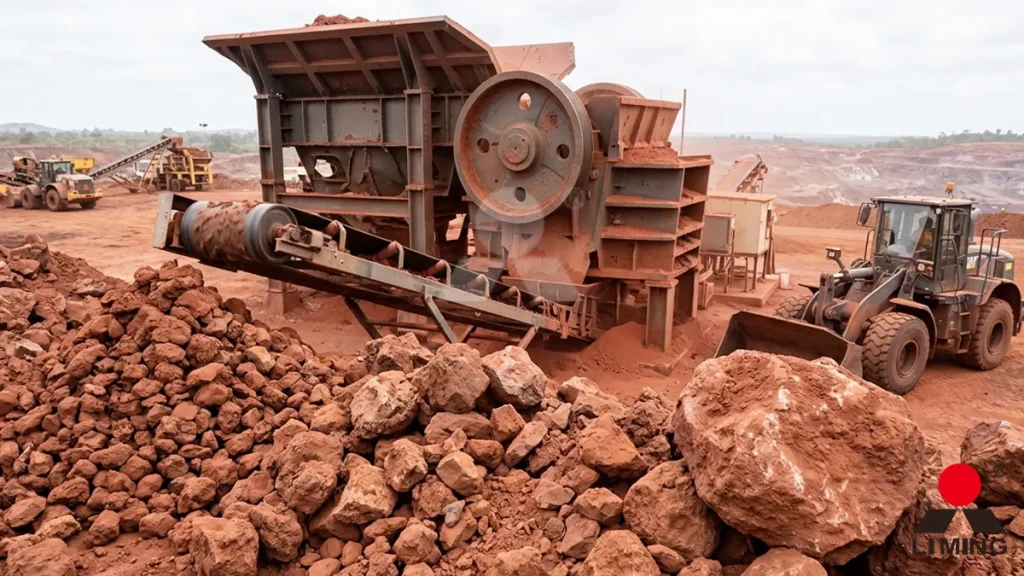
I. Identify the Ore Type First to Prevent Configuration Errors
Let us examine the primary domestic ore type: diaspore-type bauxite. Taking the accumulation-type mining districts in Pingguo, Guangxi as a benchmark, public technical data indicates that the compressive strength of the ore frequently falls between 80 and 110 megapascals (MPa). For primary crushing equipment, this represents a standard hard-rock operating condition.
Therefore, the configuration focus for this type of ore rests on two pillars: first, the machine’s structural frame must withstand immense kinetic impact; second, the wear parts (such as the jaw plates) must endure extreme abrasion.
There is a common misconception that must be corrected here: high mud content is not exclusive to soft ores. The accumulation-type bauxite in Pingguo is notorious for its extremely high mud content; sticky clay adheres tightly to the surface of the hard rock, requiring aggressive washing to detach. Therefore, configuration must be evaluated across two dimensions: the mineral type determines the hardness and wear resistance requirements, while the deposit type determines whether pre-screening and aggressive ore washing are mandatory before crushing.
II. Core Configuration Principles for Primary Bauxite Crushing
Once the ore type is identified, the second step is matching the machine to the profile. For hard ores, structural integrity is paramount. The PE Series Jaw Crusher from Liming Heavy Industry utilizes a moving jaw assembly cast from premium steel, a heavy-duty eccentric shaft machined from forged blanks, and a deep, dead-zone-free crushing cavity. It delivers a massive crushing ratio and easily withstands the brutal shock loads inherent in hard-rock operations.
Taking the PE900×1200 as an example: with a feed opening of 900 by 1200 millimeters and a maximum allowable feed size of 750 millimeters, it delivers a processing capacity of 160 to 380 tons per hour. A single unit is sufficient to anchor a million-ton-per-year bauxite production line. However, the loose bulk density of bauxite is approximately 1.3 to 1.5 tons per cubic meter, which is lower than the standard limestone density used to calibrate equipment nameplates. During selection, engineers must strictly recalculate and derate the processing capacity based on this specific density.
For materials with excessively high mud content, the configuration logic shifts: ensuring smooth discharge becomes the priority. The C6X Series Jaw Crusher features a highly optimized V-shaped deep cavity that actively resists material bridging and blockages. When paired with an F5X Series Vibrating Feeder equipped with grizzly bars, the fine mud is pre-screened and bypassed before it ever enters the crushing cavity, drastically reducing the risk of a mechanical choke.
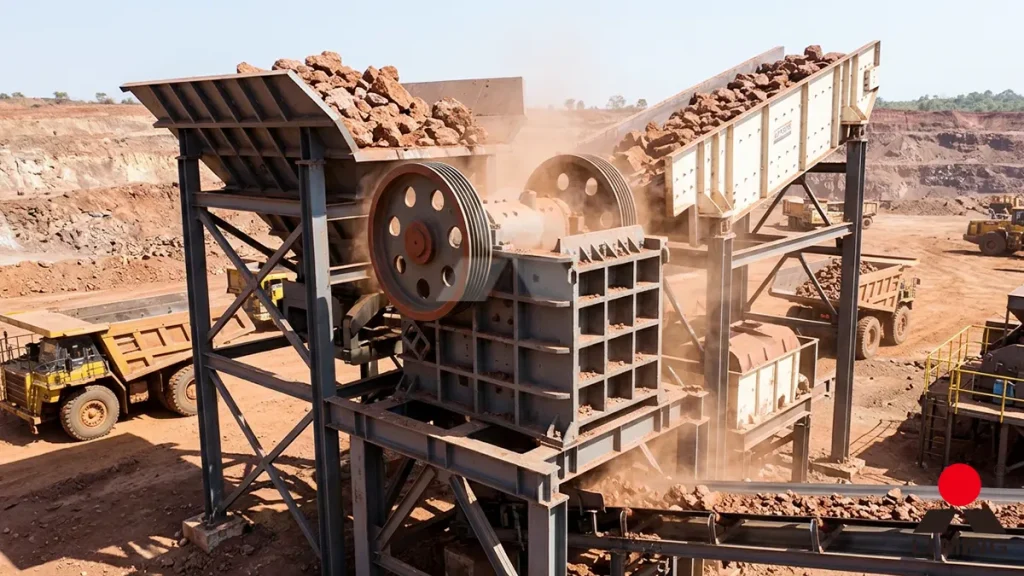
III. Transitioning from Crushing to the Grinding Circuit
Once the primary equipment is secured, engineers must evaluate where the crushed material is going. Bauxite is fed almost exclusively into the grinding mill systems of alumina refineries. While the refinery does not care about aggregate particle shape (cubicity), its requirements for the mill feed size are absolutely rigid. According to the current technical design codes for alumina refineries, the crushed product size should ideally be smaller than 12 millimeters, and the absolute maximum particle size must not exceed 15 millimeters.
This strict requirement executes the metallurgical doctrine of “more crushing, less grinding.” The design codes confirm the financial logic: for an 800,000 ton-per-year alumina refinery, dropping the crusher discharge size from 25 millimeters down to 12 millimeters reduces the grinding circuit’s electrical power consumption by approximately 8%, while the crushing circuit’s power consumption only increases by roughly 1%. Crushing the rock a little finer upfront saves the downstream grinding mills a massive amount of energy.
Whether to add a secondary crushing stage is judged entirely by this standard: if the primary jaw crusher is adjusted to its absolute tightest setting and still cannot meet the sub-15mm mill feed requirement, a secondary stage must be added. The standard engineering configuration dictates that for two-stage crushing, the secondary stage should utilize a standard cone crusher, while tertiary fine crushing should deploy a short-head cone crusher, such as the advanced HPT Series Multi-Cylinder Hydraulic Cone Crusher.
There is another critical detail often ignored on site: as the manganese jaw plates wear down, the discharge size gradually becomes coarser, directly degrading ball mill efficiency. Bauxite plants must establish a strict periodic inspection schedule for the jaw plates. The moment the particle size drifts out of spec, the discharge opening must be recalibrated. The PE series utilizes a mechanical shim adjustment, which offers a wide adjustment range but requires the machine to be safely shut down during calibration; maintenance teams should synchronize this adjustment with planned plant shutdowns.
IV. Real-World Crushing References in Metallic Mining
Translating theory into actual projects, Liming Heavy Industry’s jaw crushers have been successfully commissioned across numerous heavy metallic mining lines.
First, consider an 800-ton-per-hour iron ore tailings upgrade project. The original heavy hammer crushers were entirely replaced by single-cylinder and multi-cylinder cone crushers paired with wet washing equipment. The primary coarse reduction was successfully shouldered by two parallel PE900×1200 jaw crushers, which continue to operate with exceptional stability.
Second, in a 200-ton-per-hour lithium ore process design, the primary crushing stage utilized a single PE900×1200 jaw crusher. An upstream F5X vibrating feeder pre-screened all fine material below 65 millimeters, and the jaw discharged into a closed-circuit single-cylinder hydraulic cone crusher for fine reduction. While lithium and bauxite are different minerals, both primary stages face identical high-hardness, high-abrasion, heavy-load conditions. The successful engineering logic from these hard-rock circuits transfers perfectly to bauxite jaw crusher selection.
Conclusion
Configuring the primary crushing circuit for bauxite ultimately comes down to three absolute engineering rules. First, identify the exact mineral and deposit type: hardness dictates structural wear resistance, while mud content dictates whether pre-screening and washing are mandatory. Second, recalculate the true processing capacity based on the specific bulk density of the bauxite, ignoring the generic limestone nameplate values. Third, reverse-engineer the required number of crushing stages based strictly on the downstream grinding mill’s maximum feed size, prioritizing discharge stability over raw theoretical capacity.