

Configuring a multi-cylinder hydraulic cone crusher requires balancing maximum feed size against targeted hourly capacity. This engineering guide details the HPT cone crusher sizing for a 300mm feed and 500 Tons Per Hour (TPH) capacity requirement. Written by a senior process engineer, the article explains why the massive HPT800 is required to physically swallow 300mm boulders, yet why the HPT500 is far more economically efficient if the upstream primary jaw crusher restricts the feed size below 243mm, thereby maximizing plant profitability.
Selecting a multi-cylinder hydraulic cone crusher requires passing two rigid engineering checkpoints: first, can the crushing cavity physically swallow the maximum incoming block size? Second, does the machine’s throughput envelope comfortably cover your target capacity? According to the current technical parameters of the HPT Series Multi-Cylinder Hydraulic Cone Crusher lineup from Liming Heavy Industry, the only machine capable of accepting a 300-millimeter feed is the massive HPT800 configured with a coarse crushing cavity. However, its starting processing capacity is 530 tons per hour (TPH), which already exceeds a 500 TPH requirement. If the incoming feed size can be strictly controlled below 243 millimeters, the HPT500 coarse cavity (which accepts 286mm and processes 395 to 680 TPH) provides a far more precise and economical mechanical match.
When you input the two rigid conditions—a feed size no greater than 300mm and an hourly output of 500 tons—into the HPT series database (which covers multiple frames and 12 distinct specifications, with tight-side feed openings ranging from 105mm to 300mm and capacities from 145 to 1000 TPH), you quickly realize that no single machine perfectly satisfies both constraints simultaneously. An engineering compromise must be made.
I. The Tight-Side Feed Opening is a Hard Limit, Not a Reference
The tight-side feed opening dimension marks the absolute maximum allowable incoming particle size. Exceeding this number means large boulders will wedge into the mouth of the cavity. A minor incident results in “bridging” and material blockages, while a severe incident exerts massive upward thrust that destroys the adjustment ring and the hydraulic locking mechanism.
Within the HPT series, the largest tight-side feed opening belongs to the HPT800 Coarse Cavity at 300mm. The HPT500 Coarse Cavity measures 286mm, the HPT400 Coarse Cavity is 250mm, and the HPT300 Coarse Cavity is 210mm.
Furthermore, seasoned plant engineers enforce a strict, time-tested safety margin: the maximum discharge particle size from the upstream primary crusher must be smaller than the maximum allowable feed size of the downstream cone crusher, ideally leaving a 15% to 20% clearance margin. Throughput capacity calculations follow this exact same 15% to 20% safety margin. If we apply a 15% margin, a 300mm tight-side feed opening requires a sensible maximum incoming feed size of 255mm. If we apply a 20% margin, the absolute upper limit for the incoming feed is 240mm.
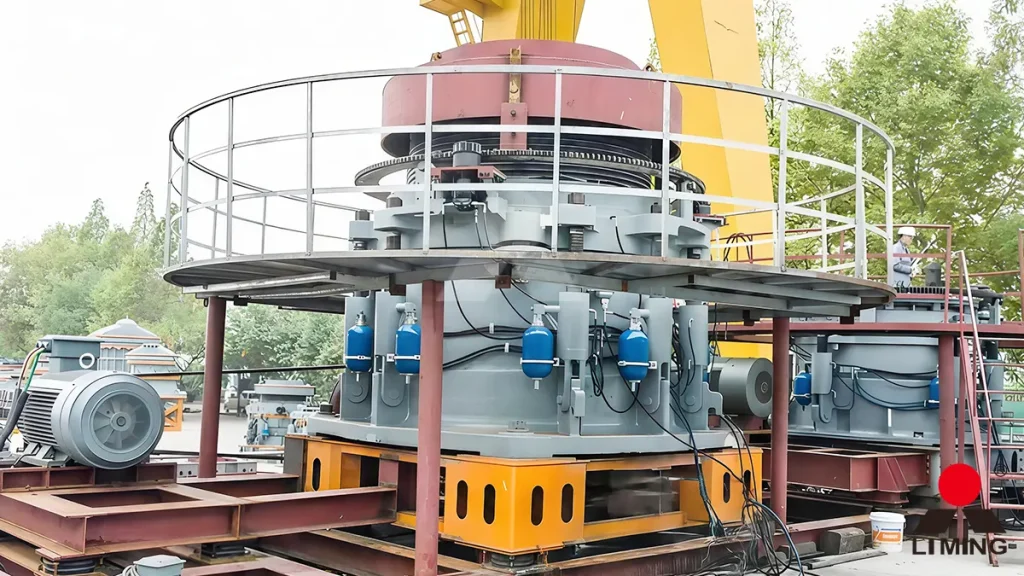
II. Where Does 500 TPH Fall on the Capacity Spectrum?
Let us cross-reference the 500 TPH requirement against the processing capacities of the models operating in this specific tier to illuminate the mechanical discrepancy.
| Machine Model & Cavity Type | Feed Opening (Tight Side, mm) | Minimum Discharge Opening (mm) | Processing Capacity (t/h) | Motor Power (kW) |
|---|---|---|---|---|
| HPT500 Coarse (C) | 286 | 30 | 395 to 680 | 400 |
| HPT800 Fine (F) | 220 | 16 | 395 to 680 | 630 |
| HPT800 Coarse (C) | 300 | 32 | 530 to 1000 | 630 |
The only cavity capable of engulfing 300mm rock is the HPT800 Coarse Cavity, but its processing capacity starts at 530 TPH. This exceeds the 500 TPH requirement, meaning the machine’s operating point falls entirely outside the optimal calibration envelope, resulting in an oversized, underutilized machine. Conversely, the HPT500 Coarse Cavity (286mm opening, 395 to 680 TPH capacity) perfectly captures the 500 TPH demand in the upper-middle section of its performance curve. The engineering trade-off is that the incoming feed size must be strictly restricted to below 243 millimeters.
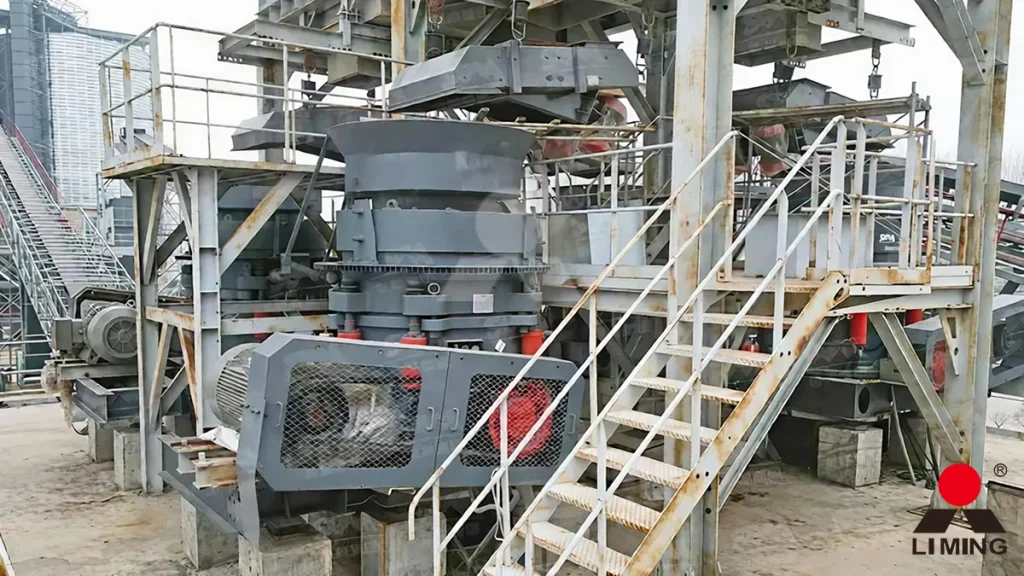
III. Field Execution: Modify the Feed, Then Select the Machine
Consider a 500 TPH dry-processing basalt production line in Chifeng, Inner Mongolia. The secondary crushing stage was configured with the HPT500 Cone Crusher. The incoming feed size was strictly managed by the upstream primary jaw crusher and an intermediate surge bin, preventing oversized boulders from ever entering the cone cavity. The operational logic of this line perfectly validates the earlier calculation: rather than purchasing an oversized HPT800 simply to handle a 300mm feed, it is vastly more economical to throttle down the feed size at the primary stage, allowing the machine model and target capacity to align perfectly.
IV. Application Boundaries and Calibration Conditions
All printed processing capacity figures carry specific calibration conditions: the material moisture content must not exceed 4%; the feed must contain no sticky clay; fine particles (smaller than the discharge opening) must represent less than 10% of the feed and be distributed evenly 360 degrees around the chamber; the loose bulk density is assumed at 1.6 tons per cubic meter; and the compressive strength must be exactly 150 megapascals (MPa).
The compressive strength of basalt and granite frequently exceeds 150 MPa. In real-world production on these hard rocks, the actual throughput will fall below the nameplate capacity range. For hard rock selection, the capacity must be derated backwards using a crushability coefficient. Furthermore, production capacity during closed-circuit operation is slightly lower than open-circuit operation; if the plant features a heavy recirculating load returning to the multi-cylinder cone, the capacity must be downgraded by an additional tier.
Finally, if the incoming feed is absolutely, unavoidably up to 300 millimeters and cannot be altered, the HPT800 Coarse Cavity is the only machine within the series capable of accepting it. In this scenario, the operator must accept the financial reality of purchasing a larger machine, or fundamentally alter the plant design by deploying two smaller HPT units in parallel. By partnering with Liming Heavy Industry, aggregate producers guarantee that their secondary and tertiary crushing circuits are sized with absolute engineering precision to minimize long-term operating expenses.