

Designing a highly profitable 400 Tons Per Hour (TPH) sand and gravel production line requires strict equipment synchronization to minimize energy consumption. This engineering guide details the optimal configuration for a 400 TPH aggregate plant. Written by a senior process engineer, the article explains the complete metallurgical flowsheet—incorporating Liming Heavy Industry’s F5X Vibrating Feeder, PEW Jaw Crusher, and HPT Cone Crushers operating in a closed-circuit loop with S5X Vibrating Screens to produce four precise commercial aggregate sizes while drastically lowering daily operating expenses.
How exactly should a 400 Tons Per Hour (TPH) sand and gravel production line be configured? In modern metallurgical engineering, the most mature and reliable approach is a highly synchronized, multi-stage circuit: Grizzly Vibrating Feeder for pre-screening + Jaw Crusher for primary reduction + Dual Cone Crushers for secondary reduction + Two stages of Circular Vibrating Screens operating in a strict closed-circuit loop to output four specific specifications of finished aggregate. In this technical guide, I will detail the specific equipment manifest, host machinery electrical consumption, and the engineered process flowsheet.
I. Understanding the 400 TPH Capacity Scale
Before configuring equipment, we must first establish the economic coordinates of this capacity tier. Calculating based on 10 to 12 hours of daily operation and 300 operational days per year, a 400 TPH plant delivers an annual production capacity of approximately 1.2 million to 1.4 million tons. This volume is perfectly scaled to supply all the commercial concrete batching plants and major infrastructure engineering projects within a county-level market. It represents the mainstream, flagship configuration for regional aggregate bases and large-scale concrete mixing stations.
Whether this capacity is considered “massive” or “medium” depends entirely on whom the plant serves. If it is supplying a regional commercial concrete market, it operates as the primary production line. If it is attached to a mega-mine processing tens of millions of tons annually, it serves as a supplementary auxiliary line. The ultimate scale is measured by local market demand, while the precise mechanical configuration is dictated strictly by the specific mineralogy of the ore and the required discharge specifications.
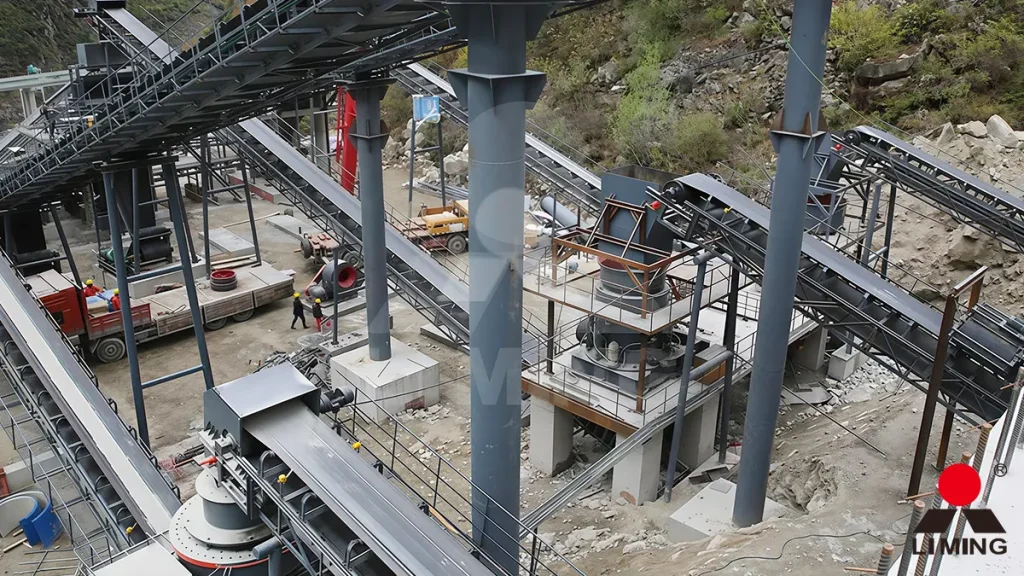
II. Complete Equipment Configuration Strategy
The engineering philosophy behind configuring this production line is simple but absolute: the three major stages—primary crushing, secondary crushing, and screening—must be perfectly balanced and fully integrated. If you compromise on any single link, both the total plant capacity and the final aggregate particle shape will be severely degraded. Below is a highly optimized configuration plan utilizing premium equipment from Liming Heavy Industry:
| Stage | Equipment Name | Recommended Model Series | Quantity | Primary Function |
|---|---|---|---|---|
| Feeding | Vibrating Feeder | F5X Series (e.g., F5X1560H) | 1 Unit | Uniform feeding and pre-screening of fines |
| Primary Crushing | European Jaw Crusher | PEW Series (e.g., PEW860) | 1 Unit | Heavy-duty primary reduction of raw boulders |
| Intermediate Feeding | Vibrating Feeder | TSW Series (e.g., TSW0936) | 2 Units | Controlled feeding to secondary crushers |
| Secondary Crushing | Multi-Cylinder Cone Crusher | HPT Series (e.g., HPT300) | 2 Units | Secondary reduction via lamination crushing |
| Primary Screening | Circular Vibrating Screen | S5X Series (e.g., S5X2460) | 2 Units | Coarse fraction classification and closed-circuit return |
| Secondary Screening | Circular Vibrating Screen | S5X Series (e.g., S5X2160) | 2 Units | Fine fraction commercial sizing |
Engineer’s Cost-Saving Analysis: This configuration incorporates two critical details designed specifically to lower daily operating expenses. First, the F5X Vibrating Feeder is equipped with a grizzly pre-screening section. Any dirt and crushed rock smaller than 65 millimeters drops through the grizzly bars and entirely bypasses the primary jaw crusher. This immediately reduces both the mechanical load and electrical power consumption of the primary crusher. Second, deploying two HPT300 cone crushers in parallel to handle the massive 400-ton throughput means that if one unit is shut down for routine maintenance, the other unit continues to run, ensuring the entire plant does not suffer from complete operational downtime.
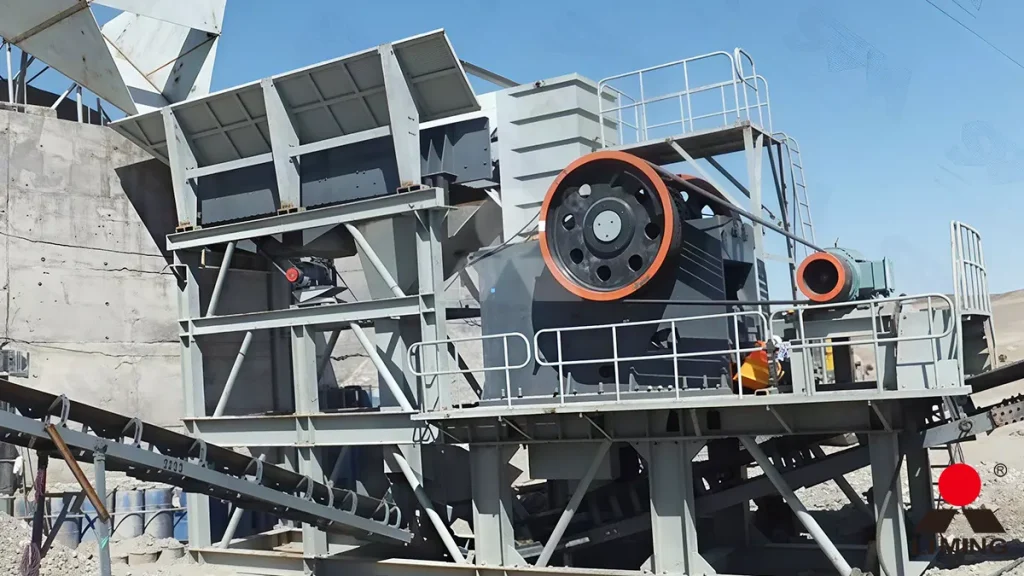
III. Process Flowsheet: Executing the Closed-Circuit Loop
The entire material flow is rigorously orchestrated. Heavy haul trucks dump the run-of-mine boulders into the massive receiving hopper. The F5X vibrating feeder first extracts all the fines below 65 millimeters. The remaining massive boulders are fed directly into the PEW Jaw Crusher for primary coarse reduction. The discharged material is then conveyed to a large intermediate surge pile.
From the surge tunnel beneath the pile, two TSW vibrating feeders extract the material evenly and send it into the two HPT Cone Crushers for secondary reduction. The crushed output is conveyed up to the first stage of S5X Vibrating Screens. Any material larger than 31.5 millimeters is instantly rejected and routed back via a return conveyor into the cone crushers for re-crushing. The material that passes through the first screen stage drops onto the second set of S5X Vibrating Screens, which precisely classify the aggregate into four distinct, commercial finished products: 0-5mm (manufactured sand), 5-16mm, 16-25mm, and 25-31.5mm gravel.
This is the absolute definition of a strict closed-circuit loop. Unqualified, oversized material never leaves the system; it is repeatedly returned for crushing until its particle shape and size are perfect. As a result, the final commercial aggregate features exceptional gradation, minimal flat or elongated (needle-like) pieces, and outstanding visual quality, allowing it to command a premium selling price in the highly competitive construction materials market.
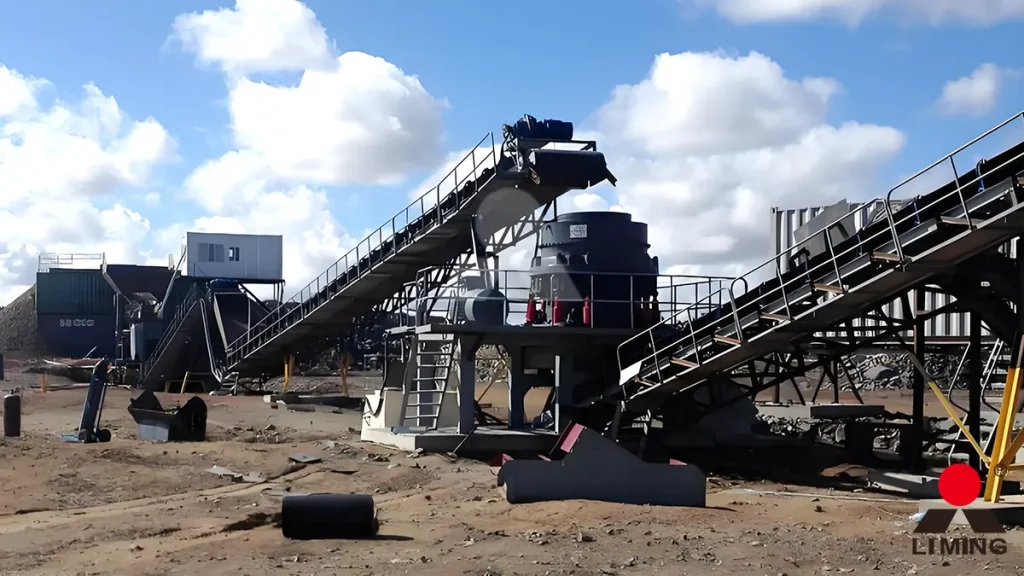
Operating the HPT Cone Crusher in a strict closed circuit with S5X Vibrating Screens guarantees that 100% of the final product meets commercial sizing standards.