

Converting gold mine waste rock into high-grade construction aggregate is an exceptional method to monetize mining refuse, provided the material suitability and sand yield per ton are calculated accurately. This engineering guide details the complete equipment configuration and economic reality of gold waste rock sand production. Written by a senior process engineer, the article explains the difference between mining waste rock and flotation tailings, details the five-stage comminution flowsheet using Liming Heavy Industry machinery, and analyzes the three variables that dictate finished sand yield.
Whether waste rock discarded from gold mining and beneficiation operations can be successfully converted into commercial construction sand on site depends strictly on two criteria: whether the material properties align with aggregate standards, and whether the sand yield per ton is calculated with engineering precision. In this technical guide, centered around the deployment of high-efficiency Vertical Shaft Impactors paired with secondary fine crushers, we will clarify equipment configurations, analyze the three variables that dictate finished sand volume, and highlight the critical environmental compliance thresholds that many operators overlook.
I. Suitable Raw Material: Mining Waste Rock versus Flotation Tailings
At an active gold mine, there are two distinct categories of “waste,” and their suitability for sand making must be analyzed separately.
Mining Waste Rock: The rock extracted during open-pit stripping and underground shaft tunneling features large block sizes and relatively low natural mud content. Before entering the primary crusher, it behaves nearly identically to standard quarry rock. This is the absolute primary feedstock for manufactured sand.
Flotation Tailings: This is the ultra-fine pulp remaining after the grinding and chemical flotation stages. Before gold flotation can occur, the ore is typically pulverized until the vast majority passes 0.074 millimeters. This particle size falls completely outside the standard construction sand envelope (0.15 to 4.75 millimeters). Attempting to use flotation tailings for construction sand will fail gradation standards; this fine material is strictly suited for underground cemented paste backfill or brick manufacturing. Conflating these two materials will result in catastrophic errors when sizing equipment.
Furthermore, there is a mandatory regulatory threshold. Gold waste rock frequently coexists with sulfide minerals, particularly arsenopyrite. Prior to commissioning equipment, the rock must undergo rigorous toxic leaching identification tests to guarantee it is not classified as hazardous waste. Once cleared of toxicity, the material must undergo radionuclide testing to ensure compliance with building material radiological safety standards. Without certified laboratory clearance on both fronts, all equipment selection calculations are meaningless.
II. The Engineering Hurdle: Extreme Abrasiveness Over Hardness
In quartz-vein gold deposits, the waste rock may not exhibit the highest compressive strength, but its abrasiveness is devastating. Hardness dictates how easily a rock fractures; abrasiveness dictates how fast it destroys the steel machinery crushing it. Quartz registers a 7 on the Mohs hardness scale. When the silica content is high, the internal components of a Vertical Shaft Impactor—specifically the high-speed rotor, alloy throw heads, and perimeter guard plates—suffer rapid abrasive wear. The replacement cycle for identical wear parts operating on quartz-vein rock is vastly shorter than on limestone.
Advanced equipment, such as the VSI6X Series Sand Maker from Liming Heavy Industry, utilizes ultra-high-chrome alloy wear parts. However, the maintenance replacement schedule must still be calibrated against the actual measured silica abrasion index of the rock. Factoring wear part consumption directly into the production cost per ton is mandatory before comparing operational costs against local aggregate selling prices. If this calculation is skipped, the plant can run at full capacity and still operate at a financial loss.
III. The Five-Stage Equipment Configuration
A reliable gold waste rock sand-making line must be engineered as an integrated comminution circuit. Every stage performs a distinct task, and individual machines cannot substitute for one another.
| Operational Stage | Recommended Machinery (Liming Heavy Industry) | Mechanical Responsibility | Key Engineering Control Point |
|---|---|---|---|
| Pre-Screening & Desliming | F5X Series Heavy-Duty Vibrating Feeder | Separates soil, clay, and pre-existing fines | Bypassing mud protects crushers from packing and prevents excessive fine dust |
| Primary Reduction | C6X Series Jaw Crusher | Reduces massive boulders down to secondary intake size | Feed opening must accommodate maximum blasted rock block dimensions |
| Secondary Fine Crushing | HPT Multi-Cylinder Hydraulic Cone Crusher | Compresses the material down to below 45mm | Focuses purely on size reduction via lamination; does not attempt fine sand shaping |
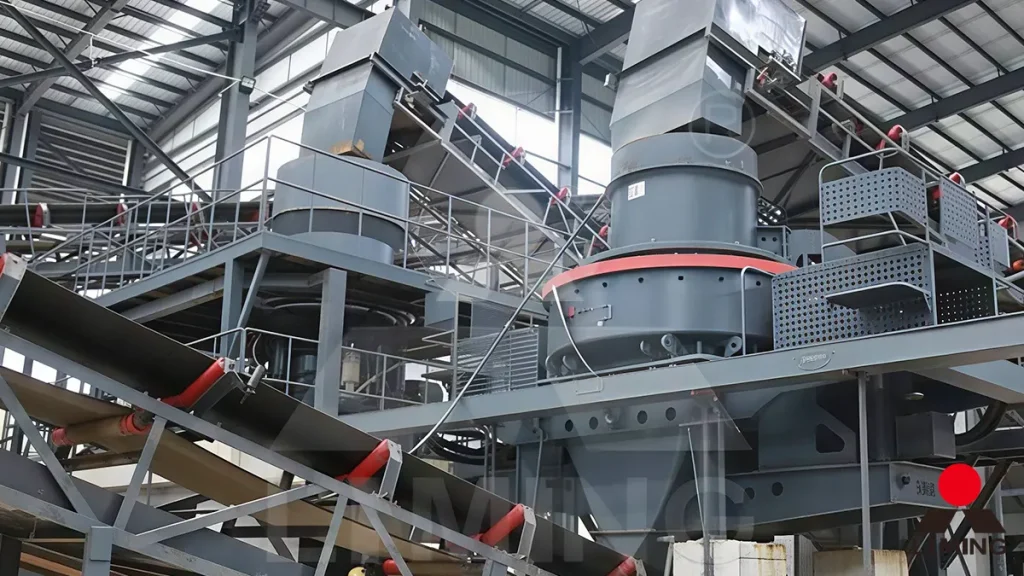
| Tertiary Sand Making | VSI6X Series Sand Maker (Vertical Shaft Impactor) | Produces 0-5mm sand and executes particle shaping | Feed size strictly capped at 45mm; oversized rock returns to secondary stage |
| Washing and Dewatering | XSD Wheel Sand Washer + Fine Sand Recovery Unit | Removes mud, controls micro-fines, captures fine sand | Washed mud and ultra-fine dust are extracted and excluded from finished weight |
A cone crusher should never be deployed to produce the final sand directly. Cone crushers utilize compressive lamination; their mechanical efficiency lies in bulk reduction. The continuous gradation and cubic particle shape of construction sand rely entirely on the high-velocity kinetic impact of a Vertical Shaft Impactor. The standard flowsheet requires the cone crusher to reduce the rock below 45mm before handing it to the VSI sand maker, while secondary roller crushers can be optionally added to process stubborn 10-20mm circulating gravel.
IV. Sand Yield Per Ton: Three Decisive Variables
There is no universal constant for how much manufactured sand can be extracted from one ton of gold waste rock. The yield is governed by three site-specific variables:
- Feed Size Distribution: The VSI6X sand maker has a strict maximum feed limit of 45 millimeters. Any material exceeding 45mm must first be crushed in the secondary cone circuit. The fines generated in that secondary stage are credited to the cone crusher, not the primary sand-making yield of the VSI.
- Finished Sand Specifications: Standard construction concrete demands a Fineness Modulus between 2.3 and 3.0. Forcing the sand to be finer requires increasing the VSI rotor velocity and tightening screen openings. This generates more rock powder, paradoxically lowering the net yield of sellable sand.
- Mud Content and Rock Powder Generation: High clay content mandates wet processing, and all washed mud is discarded from the finished tonnage. Furthermore, because gold quartz rock is highly brittle, kinetic impact generates a higher proportion of ultra-fine dust than granite. As an engineering estimate, producing one ton of qualified commercial sand typically consumes 2.2 to 2.5 tons of raw gold waste rock (representing a 40% to 45% net yield).
V. Environmental Infrastructure and Transportation Boundaries
Environmental mitigation systems must be engineered into the blueprints from the beginning; retrofitting them later increases capital expenditure significantly. In a wet-processing plant, wash water must be routed to deep-cone thickeners for recycling, fine sand recovery units must capture lost grains, and filter presses must dewater the mud into dry cakes. For dry-processing plants, pulse-jet baghouse dust collectors must be installed at all crushing transfer points.
Finally, the business model must account for the economic transport radius. Commercial construction sand has a viable road haulage radius of roughly 50 kilometers. If the gold mine is located in an isolated region lacking nearby concrete batching plants, freight logistics will consume the operating profit margins entirely.
Frequently Asked Questions (FAQ)
1. What machine model is recommended for gold ore waste rock sand making?
The primary choice is a high-speed Vertical Shaft Impactor, such as the VSI6X Series Sand Maker from Liming Heavy Industry. Operating with feed sizes below 45mm and rotor speeds between 1200 and 1400 RPM, it provides a stable capacity of 100 to over 500 tons per hour depending on the model, delivering superior particle cubicity.
2. Must gold mine waste rock sand making use a wet washing process?
If the raw waste rock contains high mud or clay, wet washing is mandatory. Utilizing an XSD wheel sand washer paired with a fine sand recovery unit strips away the mud while capturing fine sand grains. If the rock is clean and water is scarce, dry processing with air classifiers can be utilized, provided dust suppression is comprehensive.
3. What is the first thing to inspect if the finished sand yield drops?
First, inspect the pre-screening feeder and material uniformity. If natural mud is entering the crushing chamber, or if the feed surges erratically, the VSI cavity fails to remain properly choke-fed, causing the sand yield to drop immediately. Second, check the wear status of the rotor throw heads and perimeter guard plates; worn components allow oversized material to escape uncrushed.
Conclusion
Determining whether gold mine waste rock can be profitably converted into manufactured sand comes down to verifying three core datasets: the particle size distribution curve of the raw rock, the mud content and Methylene Blue (MB) value, and the rock compressive strength. Sizing the equipment fleet relies directly on these metrics.
Liming Heavy Industry provides complete Engineering, Procurement, and Construction (EPC) solutions for mine waste recycling. By pairing heavy-duty C6X Jaw Crushers and HPT Cone Crushers with advanced VSI6X Sand Makers, we ensure your waste rock processing plant maximizes aggregate quality, eliminates environmental liabilities, and secures maximum commercial profitability.