

Calculating the exact price of a mobile crushing plant requires looking beyond a single sticker price. Written by a senior engineer at Liming Heavy Industry, this guide breaks down pricing across three core components: the host crusher, chassis type, and auxiliary equipment. It explains how four operational variables—capacity, rock hardness, chassis mobility, and dust suppression—dictate capital expenditure, helping quarry owners evaluate total lifecycle value against long-term operating expenses.
How much does a mobile crushing plant cost? It is impossible to answer with a single, flat price quote. The total price is dictated by three fundamental structural components: the host crusher (which establishes the price ceiling), the chassis type (which dictates mobility costs), and the auxiliary equipment (which depends on how complete the automation and screening configuration must be). Superimposing four operational variables—production capacity, raw material hardness, chassis architecture, and auxiliary configurations—explains why quotations vary so drastically.
I. Three Core Price Components: Host, Chassis, and Auxiliaries
The financial breakdown of any mobile crushing plant is divided strictly into three parts.
The Host Crusher: This represents the largest portion of the budget. Whether you select a jaw crusher, a hydraulic cone crusher, a horizontal impact crusher, or a vertical shaft sand maker directly establishes the baseline price ceiling of the mobile unit.
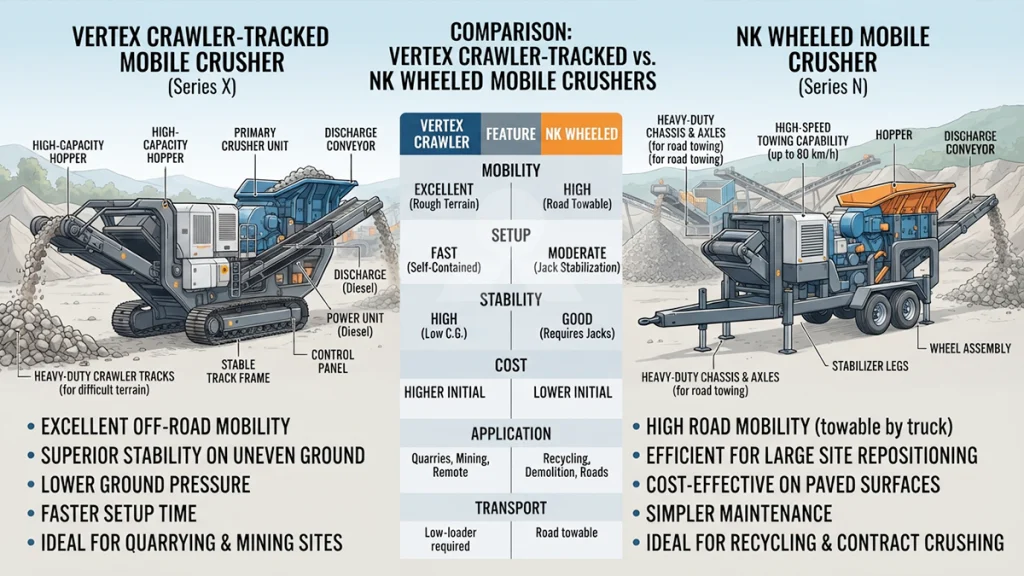
The Chassis Architecture: This is the second major cost center, divided into three types: skid-mounted (modular), wheeled semi-trailer (such as Liming Heavy Industry’s NK Series), and hydraulic crawler-tracked (such as the Vertex Series). The cost of a crawler-tracked chassis is significantly higher than that of a skid or wheeled frame. That premium pays for self-propelled hydraulic track drives and immense structural frame rigidity, with price gaps widening dramatically as machine weight scales up.
Auxiliary Equipment: This third component encompasses vibrating feeders, multi-deck screens, folding belt conveyors, and dust or noise suppression systems. How extensively these auxiliaries are configured directly drives the final price; the more comprehensive the plant, the higher the proportion of the total budget dedicated to auxiliary machinery.
A skid-mounted unit holding a single small jaw crusher and a multi-unit tracked fleet carrying a jaw crusher, multi-cylinder cone crusher, and sand maker can differ in price by multiples. Therefore, before asking for a quotation, you must clearly define your host crusher, chassis type, and target hourly capacity. Without locking in these parameters, any price quote lacks an engineering basis for comparison.
II. Where Mobile Plants Save Money and Where They Cost More
Evaluating the price of a mobile plant requires looking beyond the equipment invoice to calculate both the expenses it eliminates and the extra engineering costs it introduces.
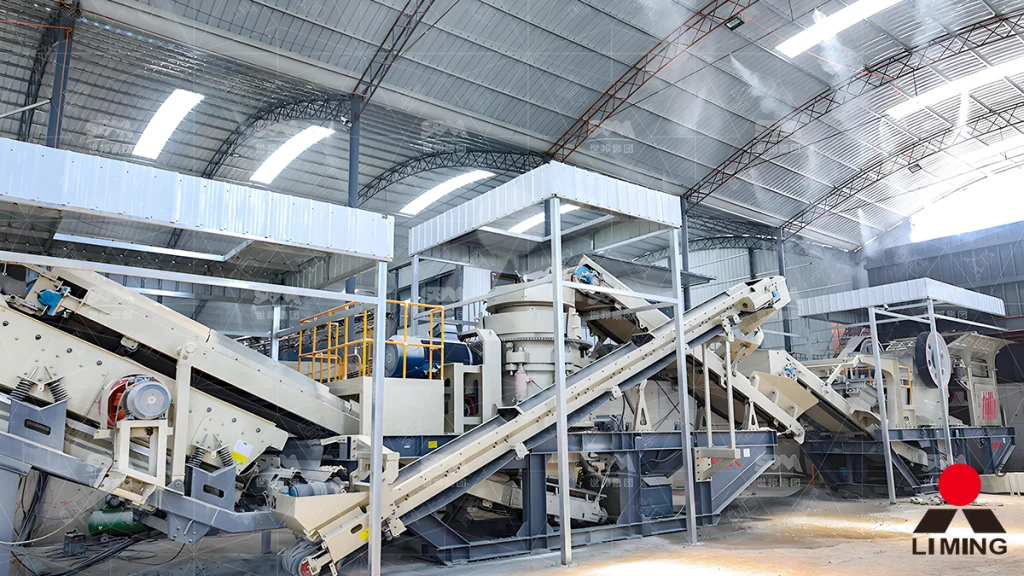
Where it saves money: Because a mobile plant requires zero poured concrete foundations and can be relocated as a unified unit, it completely eliminates civil construction expenses and teardown relocation fees. Furthermore, modular pre-assembly allows for rapid deployment, saving months on your construction timeline. On a 250 Tons Per Hour (TPH) gold ore line engineered by Liming Heavy Industry for a client in Ghana, we delivered a skid-mounted modular plant pairing a heavy-duty C6X Series Jaw Crusher with an HPT Multi-Cylinder Cone Crusher. The facility was completely assembled and commissioned in just 7 days, requiring no poured concrete foundations and no enclosed factory buildings—effectively wiping out the civil engineering budget.
Where it costs more: Mobile plants carry a price premium for the load-bearing chassis and modular connection interfaces. The steel frame must possess extreme structural rigidity to carry heavy vibrating crushers, and the modular design requires quick-disconnect electrical and conveyor interfaces that stationary lines do not need. This extra capital expenditure is only amortized and recovered on projects involving frequent site relocations, tight construction schedules, or temporary borrow pits. For permanent mines operating in one fixed spot for decades, a stationary line remains vastly more economical.
III. Four Operational Variables That Dictate the Price Range
Four primary variables shift the quotation from one tier to the next:
- Production Capacity: Stepping up from 250 TPH to 500 TPH or 800 TPH shifts the host crushers up a full frame size, increasing price exponentially.
- Material Hardness: Abrasive hard rocks (like granite or basalt) demand expensive multi-cylinder hydraulic cone crushers, whereas soft rocks (like limestone) can utilize much cheaper impact crushers.
- Chassis Architecture: Skid-mounted plants offer the highest economic value; wheeled semi-trailer plants sit in the middle; and self-propelled tracked crawler plants represent the highest cost tier.
- Auxiliary and Component Sourcing: Adding dust collection, noise enclosures, wet sand washers, or overband magnetic separators increases the price item by item. Similarly, specifying imported hydraulic components and electric motors raises the baseline manufacturing cost compared to standard domestic assemblies.
Table 1: Engineering Variables Impacting Mobile Crusher Pricing
| Variable | Configuration Options | Impact on Total Price |
|---|---|---|
| Capacity | 250 / 500 / 800 TPH | Dictates host crusher frame sizing; pricing scales up sharply per tier |
| Material Hardness | Hard Rock / Medium-Hard / Soft | Hard rock mandates costly HPT multi-cylinder cones; soft rock uses CI5X impactors |
| Chassis Architecture | Skid-Mounted / Wheeled / Tracked | Tracked crawler chassis command the highest structural and hydraulic costs |
| Auxiliary Systems | Dust suppression / Washing / Magnets | Each specialized module adds directly to the project capital expenditure |
| Component Sourcing | Standard Domestic / Imported Components | Specifying imported hydraulic pumps and motors elevates the equipment price |
Note: This matrix illustrates directional pricing impacts rather than fixed quotations; exact pricing depends on specific machine models and project inquiries.
Only when these four variables are clearly defined can a meaningful price range be discussed. How should you request a comparable quote? Compile an inquiry sheet explicitly listing your target capacity, rock hardness, preferred chassis type, and required auxiliaries. Asking “how much is a mobile crusher” without specifying these variables makes it impossible for any legitimate manufacturer to provide an accurate figure.
IV. Application Boundaries: Which Projects Should Choose Mobile?
Mobile plants are tailored for operations involving frequent relocations, urgent project deadlines, and shifting extraction zones—using the saved concrete foundation and demolition costs to pay off the higher chassis investment. They are entirely unsuited for permanent, decades-long mines requiring massive throughput or sprawling, multi-tank wet sand washing workshops.
To determine your optimal route, clarify four metrics: project lifespan, relocation frequency, capacity demand, and material complexity. If the project duration is short, moves are frequent, capacity is moderate, and the rock is clean enough to avoid complex washing, a mobile plant is an exceptional asset. Otherwise, a stationary crushing plant is the safer financial bet. Choosing between mobile and stationary means comparing total lifecycle investment, never just the price of an isolated machine.
V. Frequently Asked Questions (FAQ)
1. How much does a mobile crushing plant cost?
There is no single fixed price. The final cost is dictated by three core assemblies (the host crusher, the chassis, and auxiliary machinery) and modified by four variables (capacity, rock hardness, chassis style, and environmental configurations). Quotations must be generated per custom configuration.
2. Why do price quotes for different “mobile crushers” vary so drastically?
Because “mobile crusher” can describe anything from a single skid-mounted jaw crusher up to a massive, multi-unit tracked fleet carrying primary jaws, multi-cylinder cones, and sand makers. Additionally, costs vary widely across skid, wheeled, and hydraulic crawler undercarriages.
3. Why is a mobile plant more expensive than a stationary plant?
The premium stems from the heavy-duty structural steel chassis, self-propelled hydraulic tracks or highway axles, and modular quick-connect interfaces. This extra capital expenditure is recovered only when the plant saves significant concrete pouring and relocation costs across multiple sites.
4. What types of projects are unsuitable for mobile crushing plants?
Permanent quarries with over ten years of fixed reserves, ultra-large capacity demands exceeding thousands of tons per hour, or operations requiring massive wet sand washing and water clarification tanks are vastly more economical using permanent stationary plants.
5. What details should I prepare before requesting a mobile plant quotation?
Prepare a clear technical inquiry listing your target hourly capacity, raw material hardness and feed size, desired finished product sizes, preferred chassis type (skid, wheeled, or tracked), and whether you require imported hydraulic/electrical components. Providing these details allows engineers at Liming Heavy Industry to generate an accurate, comparable proposal and lower your long-term daily operating expenses.